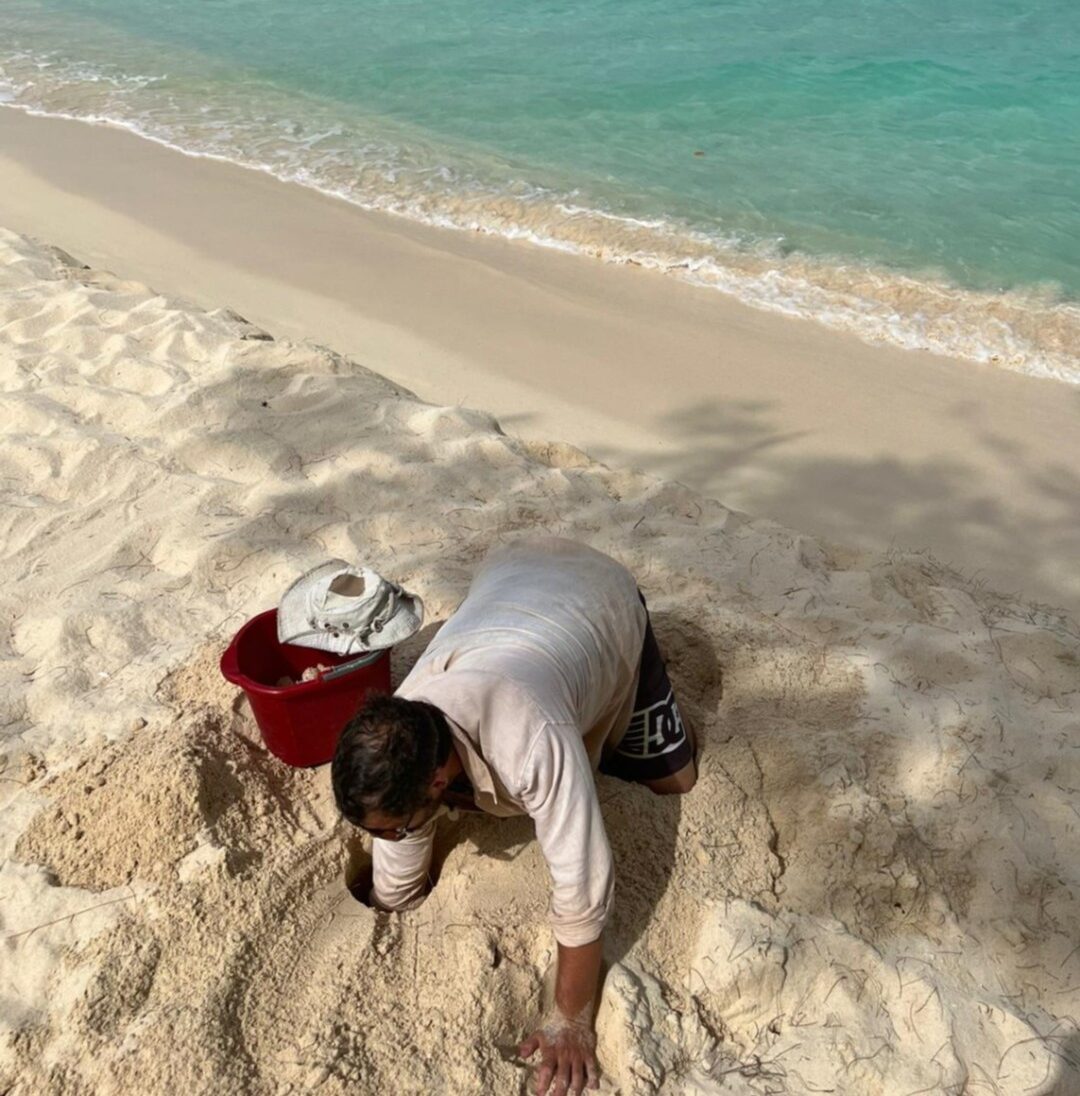
A Loggerhead sea turtle nest in risk of being washed away was rescued and relocated after it was found too close to the high water mark.
The eggs in the nest got a helping hand from Department of Environment research officer Leah Grant and visiting scientist Joe Roche, the DoE said in a Facebook post
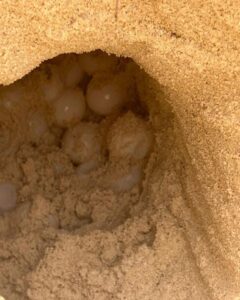
The location of nests are not disclosed to ensure the hatchlings are not disturbed and to guard against poaching.
The DoE, in an emailed response to queries from the Cayman Compass, added that relocation was performed because it was in an area of high sand mobility.
“Turtle nests sometimes have to be relocated due to their proximity to the water’s edge. Coming into storm season, we see increased chances of big surf where waves will repeatedly wash over nests that are too close to the edge or even wash out the beach sand entirely,” the DoE said in its response.
Turtle nests, it explained, can survive some limited storm impacts but “long term inundation, repeated washing over or washing out the sand, can and often does, kill the nest by drowning the eggs/turtle hatchlings”.
Storm activity poses a serious threat
Last year, 141 nests (26.5% of nests) were washed over by waves as Cayman was impacted by the active 2021 hurricane season.
For the 2022 hurricane season, the US National Oceanic and Atmospheric Administration (NOAA) is forecasting a likely range of 14 to 21 named storms, of which 6 to 10 could become hurricanes, including 3 to 6 major hurricanes (category 3, 4 or 5; with winds of 111 mph or higher).
The 2022 Atlantic Hurricane season is expected to be above-average, making it the seventh consecutive year of such a prediction.
“The increased numbers and intensity of storms are an unfortunate consequence of climate change. Sea turtles are an integral part of Cayman Islands heritage and we strive to adapt our management to these changing conditions,” the DoE said.
Related Videos