

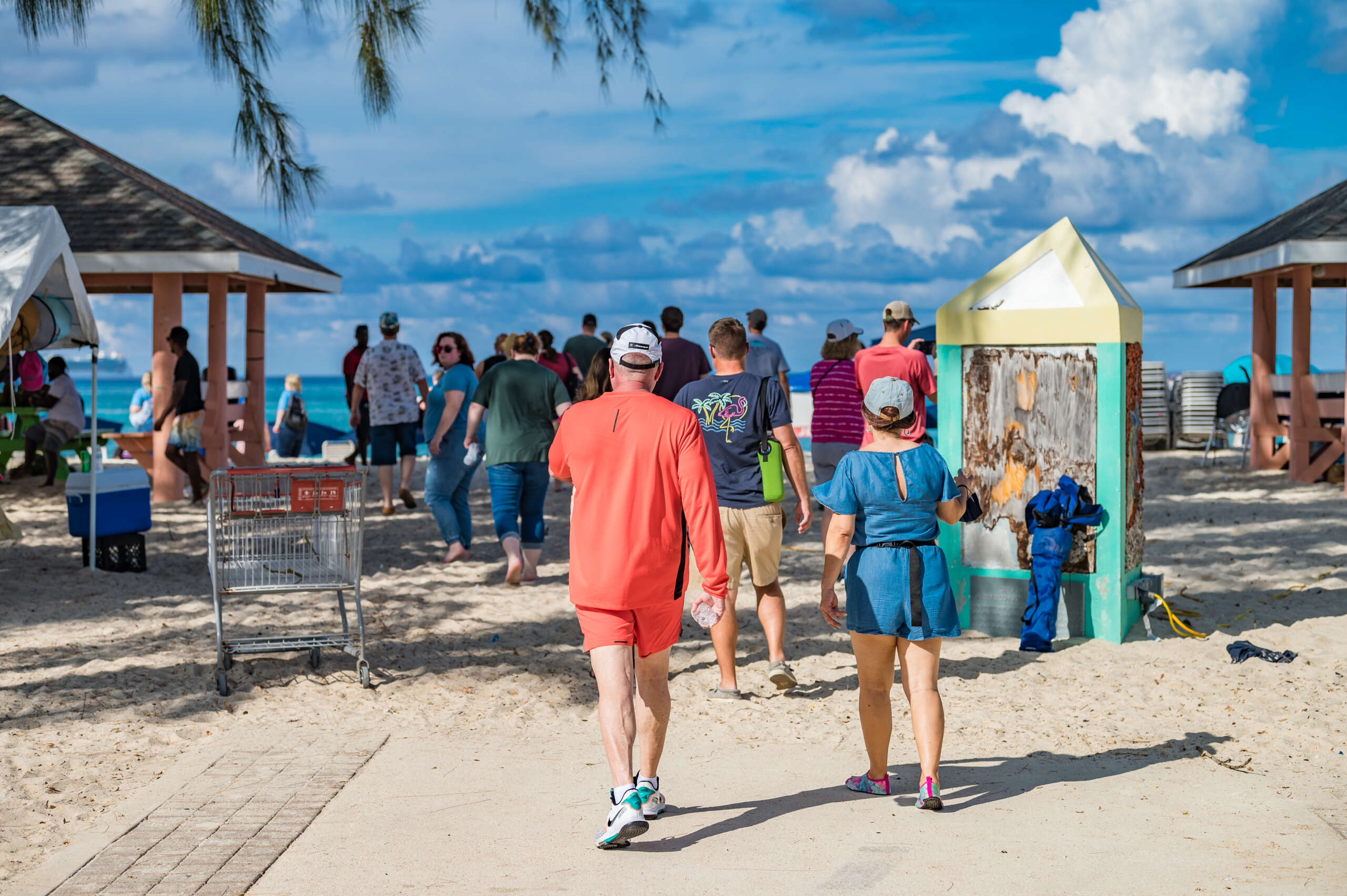
The ‘Wild West’ scene at Public Beach is a flashpoint for much larger questions over what Cayman’s tourism product should look like.
The bustling hub of unlicensed and unregulated trade at the popular seaside spot has become a locus for differing and divergent visions of the future of tourism in Cayman – with ordinary people’s livelihoods caught up in the discussion.
The upscale, upmarket image pitched by glossy advertising campaigns that entreat us to ‘Dream in Cayman’ seem at odds with the chaotic scenes at Public Beach, where rival traders clamour for business.
Much of the commerce taking place is legitimate, though all of it is currently unlicensed for the beach and elements of it are likely illegal.
It’s a poor advertisement for Cayman and a potential lawsuit waiting to happen. We are encouraged to hear that government is finally planning to follow through with plans for a licensing system.
But the scenario playing out on the soft white sands of Seven Mile is a microcosm of a wider identity crisis for Cayman.
As cruise tourism declines and diminishes, policymakers are rightly targeting an upscale product that prioritises higher spending visitors.
But how do we ensure the authentic Cayman experience, and the people who provide it, don’t get left behind in the reshuffle?
Drinks in hand, toes in sand
There are almost certainly more Caymanians – many of them legitimate business owners and entrepreneurs – on Public Beach, selling jerk chicken and offering deckchairs for hire, than there are on the frontlines of the islands’ five-star resorts.
And, as one reader pointed out, it would be a mistake to assume the casual experience they offer is necessarily at odds with the desires of the well-heeled tourists Cayman seeks to attract. ‘Drinks in hand, toes in sand’ is a vibe that anyone can get behind.
Tourists who come to the Caribbean at this time of year are seeking escape from the grind of daily city life. As temperatures plummet in much of the world, there is solace (and soleil) in the authenticity and simple charm of beach life in Cayman.
Related articles
Part of the pay-off comes in posting a video to social media – a machete slicing into the fresh coconut you just bought, having collapsed into a hired deckchair under a shady umbrella after a jet ski ride, Cayman’s sea of palest emerald the envy of friends and family bundled up back home.
You can’t manufacture that kind of atmosphere and there is an argument that Public Beach offers a more authentic Caymanian experience than many of the islands’ hotels.
The mantra of ‘retrain and retool’, which successive governments have espoused for those workers that earn their crust from cruise, including those on Public Beach, is a pipe dream.
It is hard to see beachside entrepreneurs, legitimate or otherwise, swapping the rough-and-ready atmosphere of self-employment on Seven Mile to pull on a uniform and work poolside for an hourly wage at a big hotel.
The same goes for the bus drivers, tour operators, snorkel crews, cabbies and souvenir salespeople who rely on high-volume cruise arrivals for their daily bread.
Life after cruise
But if cruise line projections come to pass, passenger numbers will almost halve within two years.
The Compass is a firm supporter of a quality-over-quantity approach to tourism. And while some will again make the case for a cruise port, it is fair to say that ship has sailed.
That doesn’t mean our problems go away, however. The decline of cruise tourism on the scale anticipated is a seismic challenge for Cayman’s policymakers. The scramble for trade at Public Beach is an early sign of trouble ahead, with struggling businesses and sole entrepreneurs left to squabble for a shrinking piece of the pie.
We need to confront the reality of life after cruise.
It is an issue the Compass will tackle in a series later this year: How do we prepare? How do we upscale the product and keep Caymanians employed at the same time? How do we fill the lacuna for tourists who want the barefoot, affordable experience once found at Calico Jack’s and Royal Palms?
Following Compass reporting, government responded that a long-awaited policy for issuing permits to vendors on Public Beach should be in place by early next year. This represents a potential solution to several of these issues, if the concessions are granted and regulated by the tourism department and limited to a small number of Caymanians who can prove they offer an authentic and well-run business that enhances the overall product.
Some will see this approach as caving in to vendors who have pushed the envelope of legality by taking over the beach to ply their trade.
Others see the kind of creative compromise that will be required to ensure a place for small Caymanian operators, even as the sector evolves.
It is an approach that will need to be replicated across the islands. The lesson of Public Beach is that government can’t sit on its hands and wait to see what happens. Significant changes are coming to Cayman’s tourism product and we need to be proactive in shaping the response.
The right moves now will help make ‘Dream in Cayman’ a reality for those who build it, as well as those who enjoy it.
Related Videos








As someone who comes to Cayman and spends tens of thousands of dollars each year, let me offer my opinion. Yes, folks like me come here for an upscale experience. We love the fact that at Cayman you don’t get harrassed on the beach like at many other islands. Yes, we love the big hotels but also love the smaller stays. I have stayed everywhere from a small cottage to Sunshine to the Ritz and have never had a bad trip to the Cayman Islands – love all the experiences.
My suggestion is to license and TRAIN the local merchants. Create, enforce, and support the merchant’s village at public beach. But I would not stop there. The big hotels should have shops for the top local merchants to offer direct island products and services to guests. Don’t limit them to public beat but limit poor behavior which hurts the tourism experience.
I would love to train merchants and double or triple the number – but with a greatly improved experience for them, for tourists, and for residents.
Cayman has an opportunity to take what is a challenge and turn it into a great benefit for all of Cayman and the people who visit. Let’s make that happen.