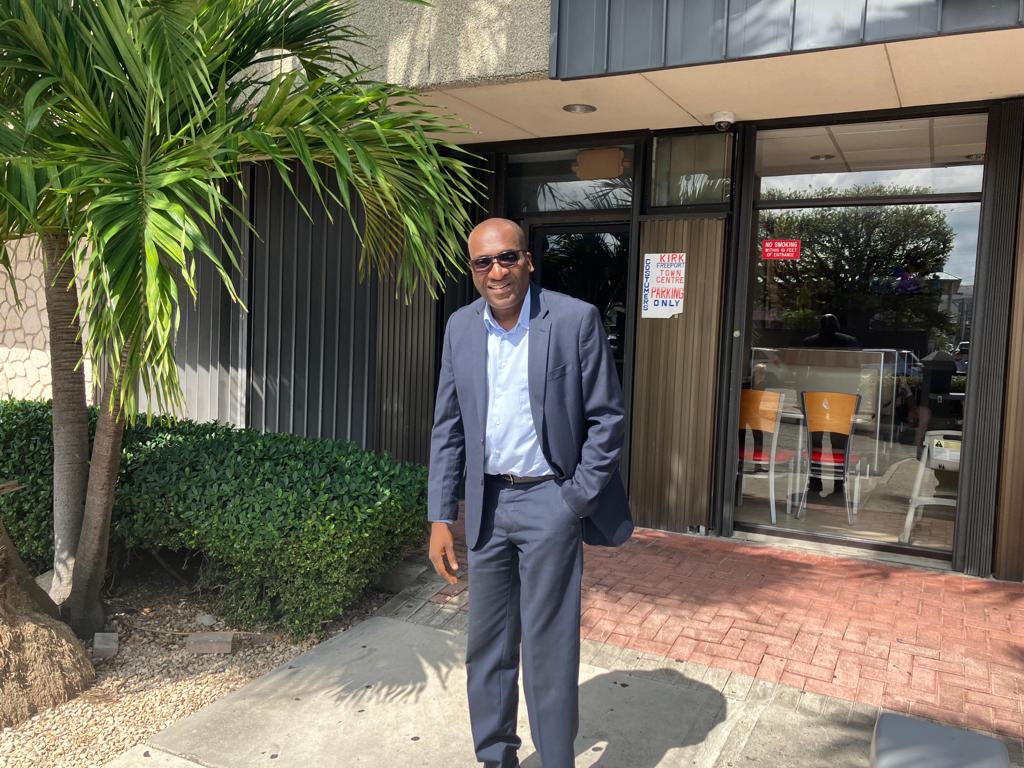
Disgraced football executive Canover Watson has been sentenced to eight years in jail following his conviction on fraud and money-laundering charges.
Related Stories
- Special report: The men who scammed the beautiful game
- Prosecutors call for lengthy prison sentences for Watson and Blake
His co-accused, former colleague Bruce Blake received a two-year prison term on related charges of false accounting.
Handing down the sentences on Wednesday, Chief Justice Margaret Ramsay-Hale said the offences had “outraged” the community.
But she also expressed sorrow at the “squandering of such immense potential”. Highlighting the two mens’ academic and professional accomplishments and contributions to society, she said they had disappointed the community and damaged the reputation of the jurisdiction.
She refuted a narrative advanced by Watson, the chief architect of the scheme, that the offences had ultimately benefitted the Cayman Islands Football Association, pointedly telling him, “there is no Robin Hood here”.
The sentences follow a trial that saw Watson convicted on all charges against him related to sending false invoices of US$1.54 million to regional football confederation CONCACAF and then laundering the stolen funds through the Cayman Islands Football Association.
Blake was cleared of money laundering but convicted on two false-accounting charges.
The prison terms fell short of the lengthy sentences called for by prosecutors.
Both men were senior officials at the Cayman Islands Football Association at the time the offences took place in 2013 and 2014.
Ramsay-Hale said the “community’s sorrow” at the offences was magnified by the prior achievements of the two men.
Addressing Watson, a former winner of the Young Caymanian Leadership Award, and Blake, an accountant and a lawyer with one of the islands’ top financial services firms, she said, “You were the absolute best that Cayman could hope for… we are so disappointed.”
Watson’s sentences
Watson was sentenced to three-and-a-half years in prison for obtaining secret commissions, two years in prison for money laundering and four-and-a-half years in prison for false accounting. The latter two sentences will run concurrently, meaning his total sentence is eight years in prison.
The ‘secret commission’ relates to payments of US$1.54m obtained by Watson from CONCACAF by presenting false invoices for sporting goods purporting to be from a Pakistani kit supplier.
In fact, the money was sent to a Panama company with a similar name, controlled by Watson, and the bulk of the soccer kits, bags and other equipment represented by the invoices, were never delivered.
At the time, Watson was a member of CONCACAF’s finance committee and his close friend Jeff Webb was the association’s president. The invoices were apparently waved through by CONCACAF general secretary Enrique Sanz, who was complicit in the scheme.
Scam took funds from young footballers
Ramsay-Hale said the fact that CONCACAF had not made a criminal complaint itself was irrelevant, and suggested the real victims were the young footballers of the region.
”Your scheme diverted funds from programmes designed by CONCACAF to develop football within that region and from the youth that grassroots programme was meant to support,” she said.
Watson’s position of trust within the organisation, as well as the impact of his crimes on Cayman’s reputation as a jurisdiction, were aggravating factors in the sentencing calculation, the chief justice said.
He was separately sentenced to two years in prison for the money-laundering charges, which relate to the transfer of the funds from his Panama company to the Cayman Islands Football Association.
The false-accounting charges, which attracted a sentence of four-and-a-half years, were linked to fake loan agreements between his Panama companies and the Cayman Islands Football Association, fabricated by Watson in an effort to explain the payments to auditors.
The money pumped into CIFA’s account enabled it to release ‘a charge’ on the Centre of Excellence building in Prospect, opening up further streams of funding from global governing body FIFA.
Watson had argued that CIFA, painted as a victim by prosecutors, had actually benefitted from the transactions.
But Ramsay-Hale said the scheme had left the local association indebted to “repay stolen funds” with interest.
“There is no Robin Hood here,” she said. “You intended loss to CIFA and a gain for yourself.”
She said the offences had also done serious reputational harm to both CIFA and CONCACAF.
Blake sentenced to two years
Blake, who allowed his signature to be used on the loan agreements, was convicted of false accounting. His role in the scheme was comparatively peripheral, and Ramsay-Hale said his acquittal on money laundering charges demonstrated that the jury was not sure he had been aware that the funds represented criminal proceeds.
She acknowledged his previous good character, that he is a father of young children, his genuine remorse and low risk of reoffending.
She noted Blake’s love of football and his contributions to the community, including contributing “hundreds of thousands of dollars” to “keep the doors of the association open” when its finances hit the rocks.
A social inquiry report recorded Blake’s shame and embarrassment and the fact that he “sees himself as a victim of Watson”.
The chief justice told him, “I venture to say the massive fall from grace and the shame you experienced as a result of your involvement in these offences is a huge deterrent to any future offending.”
However, she said, the “gravity of the offending” warranted a custodial sentence. The fact that he was an attorney and an accountant at the time of the crimes impacted public confidence in the islands’ financial services sector, she added.
Watson has indicated an intention to appeal. Blake has not yet signalled whether he plans to appeal.
Related Videos