


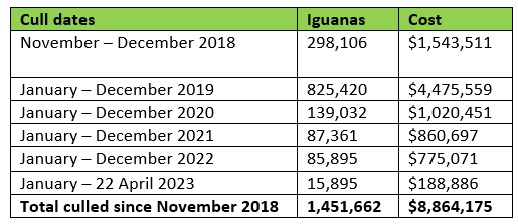
The sight of green iguanas is a lot less common nowadays than in previous years, but cullers are still hunting down the invasive species, killing nearly 16,000 of the animals so far this year.
Since the island-wide cull began in October 2018 – when Grand Cayman had an estimated green iguana population of 1.3 million – cullers have killed 1.45 million of the reptiles, and government has paid out almost $9 million in bounties.
According to the latest figures from the Department of Environment, between 1 Jan. and 22 April this year, 15,895 green iguanas were culled – an average of 142 a day.
The statistics indicate a drop in the average number of the invasive species that are being killed each day compared to previous years. Throughout the entire 2022, 85,848 were culled – a daily average of 235.
At the height of the culling, in 2019, there were 320 registered cullers on island. They captured and killed 835,420 iguanas and were paid almost $4.5 million.
According to the DoE, bounties for the culled animals so far this year have earned Cayman’s 160 registered hunters a total of $188,886 between them.
The hunters include individual cullers as well as dedicated teams, according to Fred Burton, manager of the DoE’s Terrestrial Resources Unit.
Last year, the DoE invited bids from teams of licensed air rifle operators, along with “spotters/noose operators/iguana retrievers” to work together to hunt the animals.
Explaining the move from individual hunters being paid per iguana to a new system of dedicated teams being paid by the hour, the DoE said in the bid invitation that it was “anticipated that existing bounty hunters on Grand Cayman will continue under present arrangements until they no longer find this financially worthwhile, with many of them expected to transition to the new hunting team operations as the green iguana population falls”.
Recent estimated figures for how many iguanas remain on the loose are not yet available, but statistics from a DoE annual survey carried out in August last year indicate that there were around 80,500 of the animals in the wild at that time.
The aim of the DoE, which has acknowledged that total eradication of the iguanas is unlikely, is to reduce the population to between 10,000 and 50,000.
In an article published in the DoE’s Flicker magazine following the release of those figures, the department noted that the August 2022 numbers were not too dissimilar to the 87,751 iguanas recorded the year before, which, it said, may seem discouraging at first glance.
“However, through the years we have seen a doubling of the population within one calendar year when no control measures are in place. For example, 2015’s survey estimated 408,749 green iguanas, which about doubled to 814,855 green iguanas in 2016,” the DoE stated.
Hunting the iguanas has become more difficult over the years. When the cull began, the animals could be easily found wandering through golf courses or lounging in trees in busy condo developments or boldly eating people’s flowers in their gardens.
In a presentation to the annual Virtual Island Summit in October last year, DoE Deputy Director Tim Austin said the iguanas had become more “skittish” and can now mostly be found in more remote areas, away from people.
Related Videos










Clean up the chickens this way please
Don’t stop!!!!!!! Some large ones around Spotts Beach.