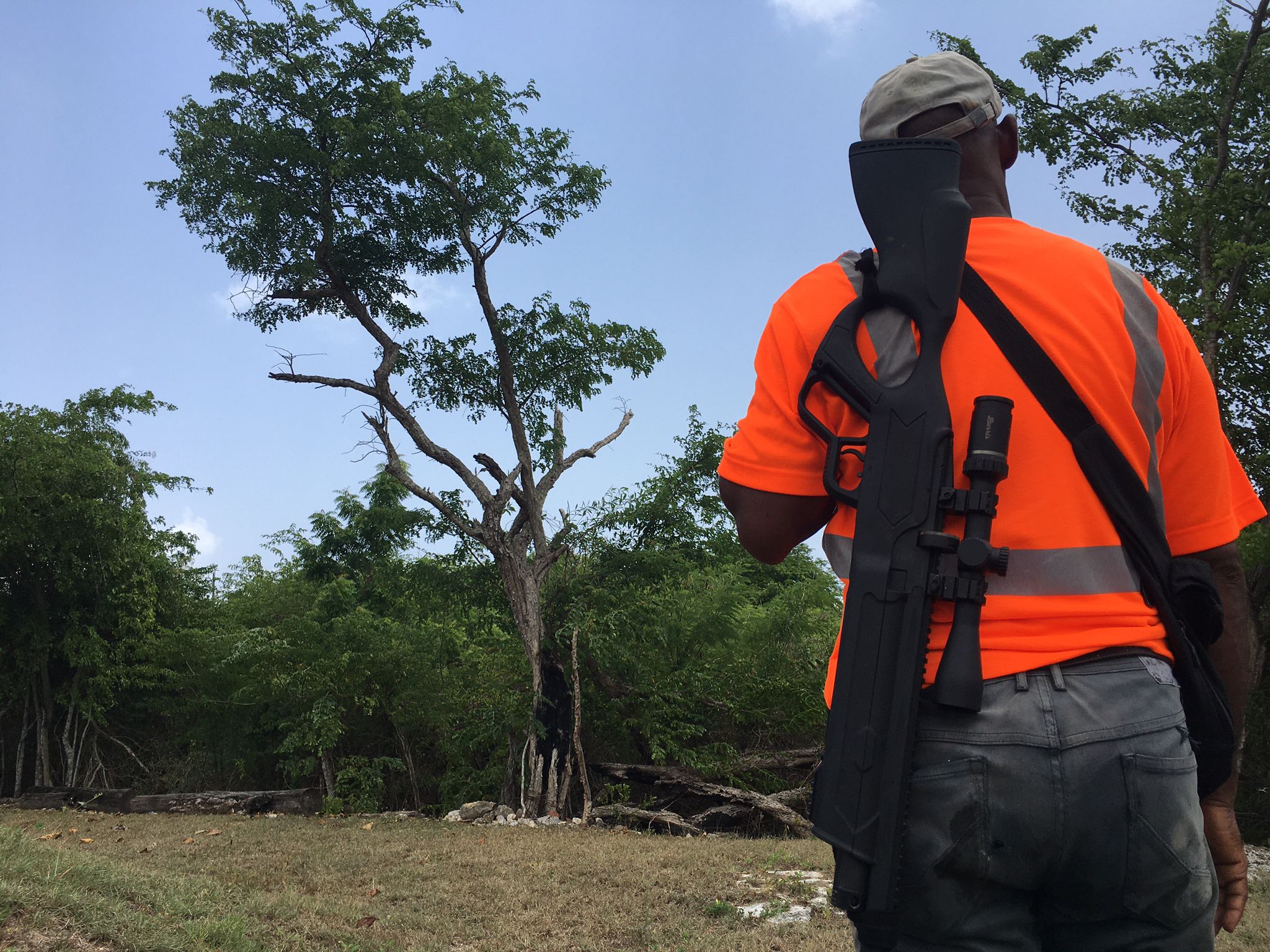
Iguana hunter Tyree Hernandez has kept his finger on the trigger and eyes on the target for nearly six years in his quest to rid the Cayman Islands of the invasive reptiles.
Hernandez, who has retired from a ‘normal’ nine-to-five job, was one of the first people to enrol in the Department of Environment green iguana-culling initiative back in 2018.
In a presentation to the annual Virtual Island Summit in October last year, DoE Deputy Director Tim Austin noted that the iguanas had become more “skittish” and can mostly be found in remote areas, but Hernandez says he isn’t having a problem tracking down the animals.
He told the Compass that he has maintained a threshold of 400 kills every month since the start of the initiative – totalling around 28,000 iguanas.
According to the latest figures from the DoE, between 1 Jan. and 22 April this year, 15,895 green iguanas were culled – an average of 142 a day.
“Iguanas will be there forever, that’s my personal opinion,” Hernandez said. “We are catching a fair share of everything. I signed up for 400, and I’ve maintained that, 400 a month.

Describing some of the iguanas he catches to be as big as young alligators, he added, “We killed 50 iguanas last night and, in that 50, we had at least 30 ‘alligators’.”
His totals represent more than one-third of the daily average being brought in by all of the cullers.
Since the island-wide cull began in October 2018 – when Cayman had an estimated 1.3 million green iguanas – hunters have killed 1.45 million of the reptiles, and the government has paid out nearly $9 million in bounties.
And if Hernandez’s numbers are accurate, that would mean out of that $9 million, with the DoE iguana payout of $5 per head, he would have earned around $140,000 over the last six years.
However, Hernandez has recruited some help over the years to share the earnings.
“I’ve had people that I’ve been working with helping me because you know it’s not every day that you are going to feel strong enough,” he said.
Opposition
But Hernandez’s efforts to blast the iguanas with his air rifle have not come without some difficulties. He noted while he has sustained his monthly kill rate, some homeowners in his culling locations represent his strongest opposition.
“We’ve been having issues with people,” he said. “I run into that same situation at Pedro [St. James], where a lady has a ‘private property’ sign on her gate,” he added, noting that though he was actually on the ironshore outside of her property, she insisted that he and his team leave the iguanas alone.
“She was taking pictures and telling us that she was going to call the police,” he said. “To the best of my knowledge, foreigners cannot own the ironshore because it’s at the sea line.”
Under the Department of Tourism-issued guidelines for owners of beachfront properties, between the high-water and the low-water marks, known as ‘foreshore’, the land belongs to the Crown.
“These are the issues the DoE needs to look into and speak to the property owners and enforce what the government has [approved].. for us to eradicate iguanas,” Hernandez added.
Related Videos