


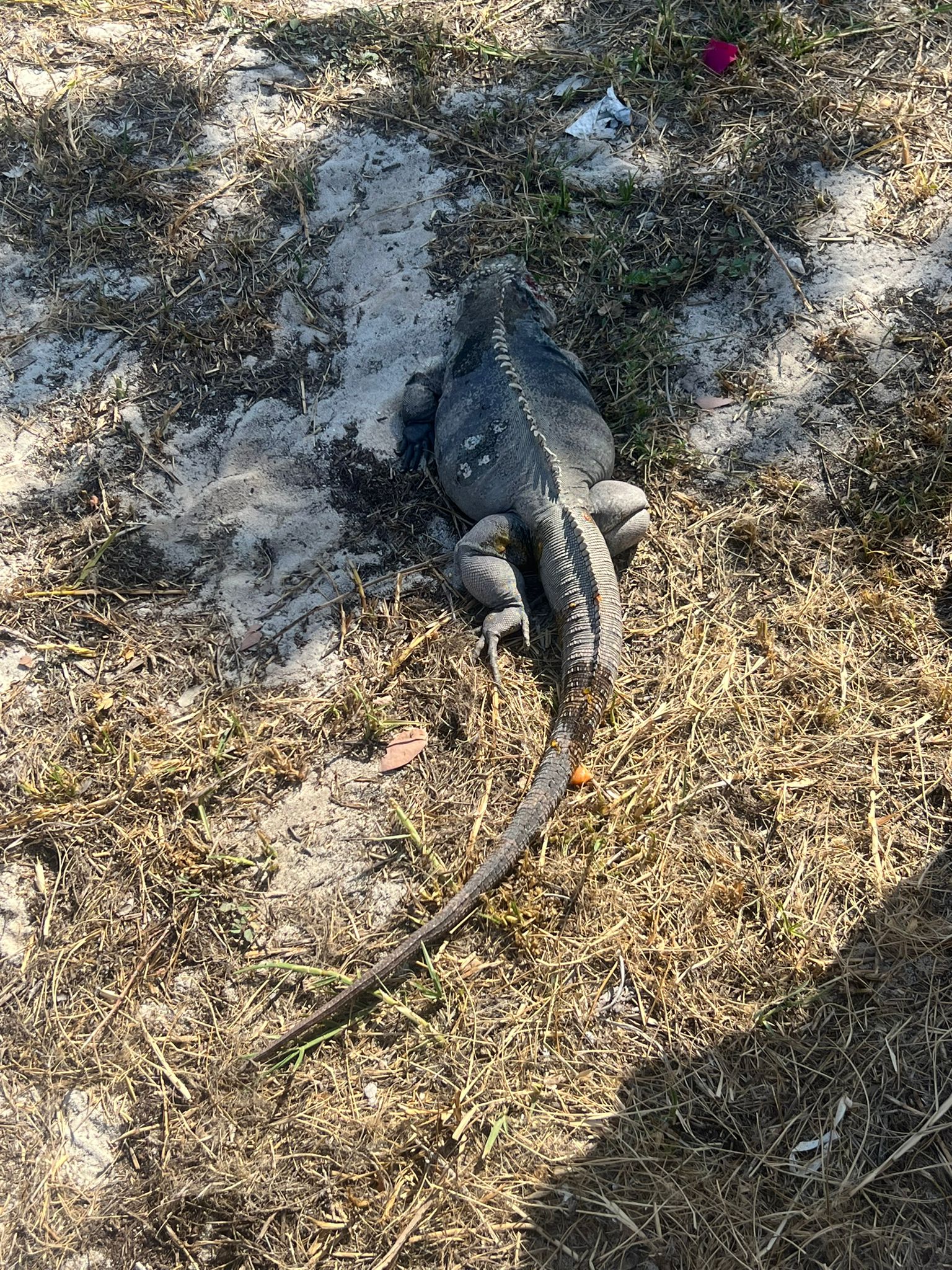
The death of a pregnant rock iguana on Little Cayman late last week has once again raised fears for the survival of the already fledging population of the endangered species on the Sister Islands.
The iguana was the sixth killed in April and the ninth to be killed this year on Little Cayman roads. Each was a victim of a speeding driver.
Last year, 26 iguanas were run over and killed in Little Cayman, and 18 were killed on Cayman Brac. These numbers could be even higher, as some road kills may be missed or scavenged off the road.

Owen Foster, who was on holiday in Little Cayman last Thursday, said he came across the severely injured iguana in Blossom Village. Despite the efforts of him and his girlfriend, they could not save the animal.
“I’ve seen iguanas dead on the road before and it’s very sad, but to be there with one as its life is coming to its end, is completely heartbreaking,” he told the Cayman Compass Sunday night.
Foster said he was driving on Thursday when a truck “raced” past him and his girlfriend.
“Then we saw [the iguana] on the road in front of Neptune’s Birth. I drove past and turned into the church parking lot to head back, and a rental car came up and pulled over, and we all got out,” he said.
He said Tamara Boyle from the Beach Resort also stopped.
“She was the one that picked it up and moved it off the road while it was still breathing. A few minutes later, [the iguana] was gone,” Foster said.
‘Road kills a major threat’
The Department of Environment Terrestrial Research Officer Vaughn Bodden, responding to Compass queries, said road kills are “a major problem” on all three islands and are impacting the populations of the Sister Islands rock iguana and blue iguana.
“Rock iguanas are especially vulnerable during their mating season, March to June, and during the hatching season, August to October, which is when they are more active on the roads,” Bodden said.
The estimated population of iguanas on Little Cayman is 1,834.
“We do not have an estimate for the Cayman Brac population, but it appears to be much smaller,” Bodden said.
Foster said he is particularly upset by the lack of regard shown for the animals, whose numbers are dwindling.
“They were here first, they are the original Caymanians, and deserve to be treated with respect,” he said.
Bodden said it is not possible to save any eggs from an iguana killed on the road.
“They are likely not fully developed if they have not been laid, so the eggs, unfortunately, are lost in any roadkill,” he explained.
Roadkills, he said, remains a major threat to rock iguanas on all three islands.
Adult iguanas are regularly hit by cars in Cayman Brac, he said, “especially along the South Coast where the rock iguanas are relatively abundant compared to other areas in Cayman Brac”.
The rock iguanas primarily use nesting sites along sandy coastal areas and migrate there during the March-June breeding season. After the eggs hatch, between August and October, the baby iguanas migrate back to inland areas, Bodden explained.
“Our coastal road network thus puts them at risk during these vulnerable times,” he said.

“The rock iguanas are also attracted to the roadside for basking opportunities throughout the year. The high number of adult iguanas being hit by cars puts pressure on an age class in the population, which usually is not impacted by large number of natural deaths, given their size.”
This, in turn, means that the population dynamics “are not evolved to support large losses in the breeding age adult iguanas”.
As a result, Bodden said, each loss of a breeding age adult has “an outsized impact” on the overall population.
He said the DoE has installed signage on all three islands in areas where road kills occur frequently and has been in touch with the police on each island to help enforce laws against reckless driving.
However, the road kills continue.
“Road kills are also partly to blame for the dramatic decrease in blue iguanas that occurred in Grand Cayman, and it is still an issue for the population along the Queen’s Highway near the Salina Reserve and Collier’s, where they are released into the wild from the Blue Iguana Conservation’s breeding and headstart programme,” Bodden said.
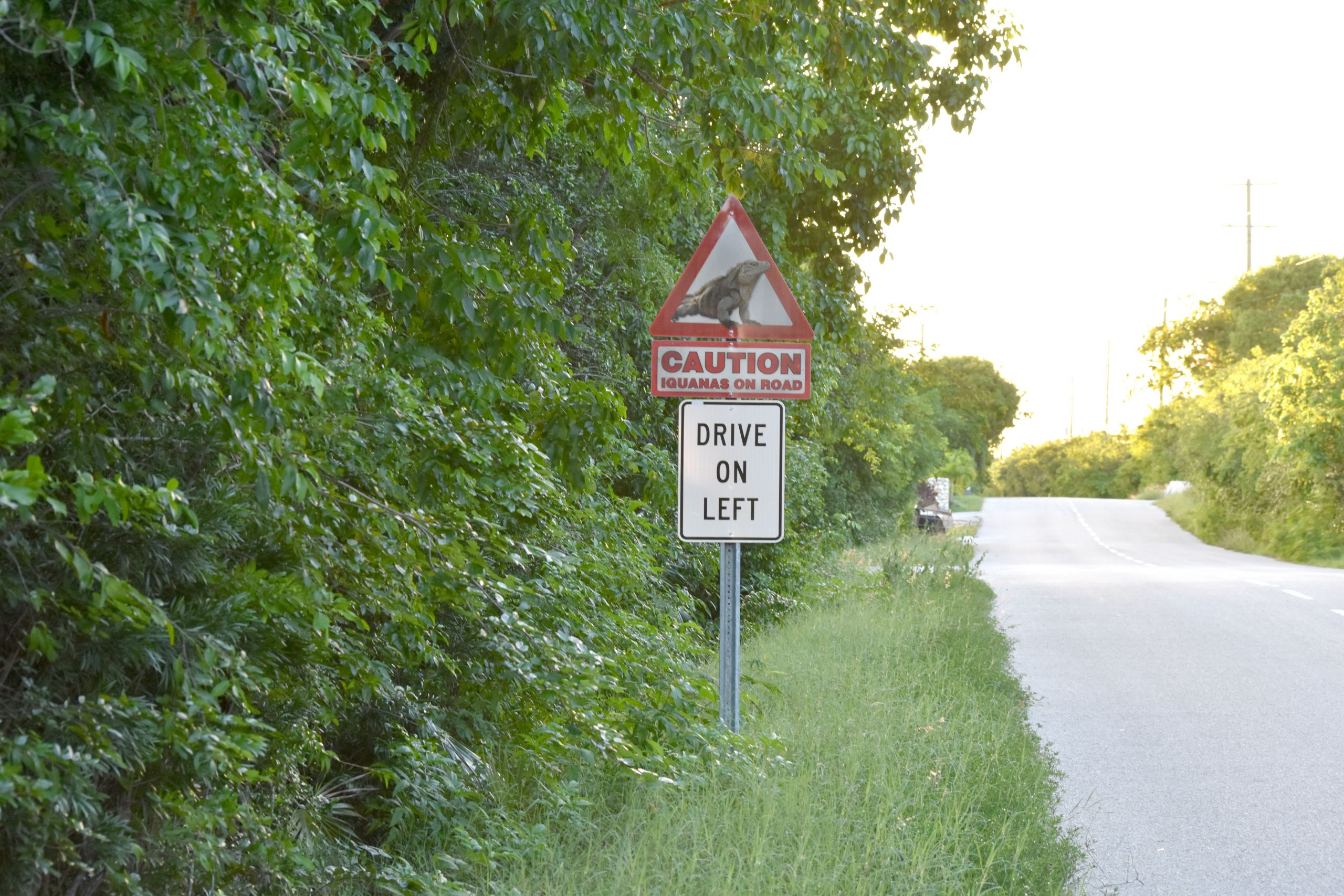
He pleaded with drivers to be careful on the Sister Islands roads and be mindful that rock iguanas may be basking in the middle of or on the sides of roads at any time.
“During the breeding and hatching season, it is particularly important to keep an eye out for any rock iguanas moving near or on the road; slow down and give them space to move. We also encourage all car rental companies to remind visitors to drive carefully and look out for rock iguanas on our roads,” he added.
He also urged residents to check under vehicles for iguanas before driving off as this contributes to accidental deaths.
All rock iguanas are protected species under the National Conservation Act, which makes it is illegal to purposefully kill them.
He urged the community to report any accident with the rock iguanas to the Little Cayman station manager at 916-5849 or the Cayman Brac station manager at 926-2584.
By the numbers: Sister Islands road kill
| Year | Little Cayman* | Cayman Brac |
|---|---|---|
| 2008 | 9 | 4 |
| 2009 | 8 | 2 |
| 2010 | 10 | 3 |
| 2011 | 7 | 7 |
| 2012 | 49 | 4 |
| 2013 | – | 2 |
| 2014 | 24 | 3 |
| 2015 | 9 | 7 |
| 2016 | 17 | 9 |
| 2017 | 25 | 7 |
| 2018 | 39 | 13 |
| 2019 | 48 | 11 |
| 2020 | 32 | 9 |
| 2021 | 24 | 12 |
| 2022 | 22 | 14 |
| 2023 | 26 | 18 |
* opportunistic data collection; effort/ reporting from public varies greatly over time.
Note that many road kills are likely missed or scavenged off the road so these numbers are likely less than the total.
Related Videos









Only two things can be done, cease and desist on development or have everyone turn in gas motor vehicles and swap out with electrical mopeds (government can do a swap out program). Unfortunately, with development means more people and more people means more cars which means more dead iguanas. You have choices. Don’t let your paradise become Grand Cayman.