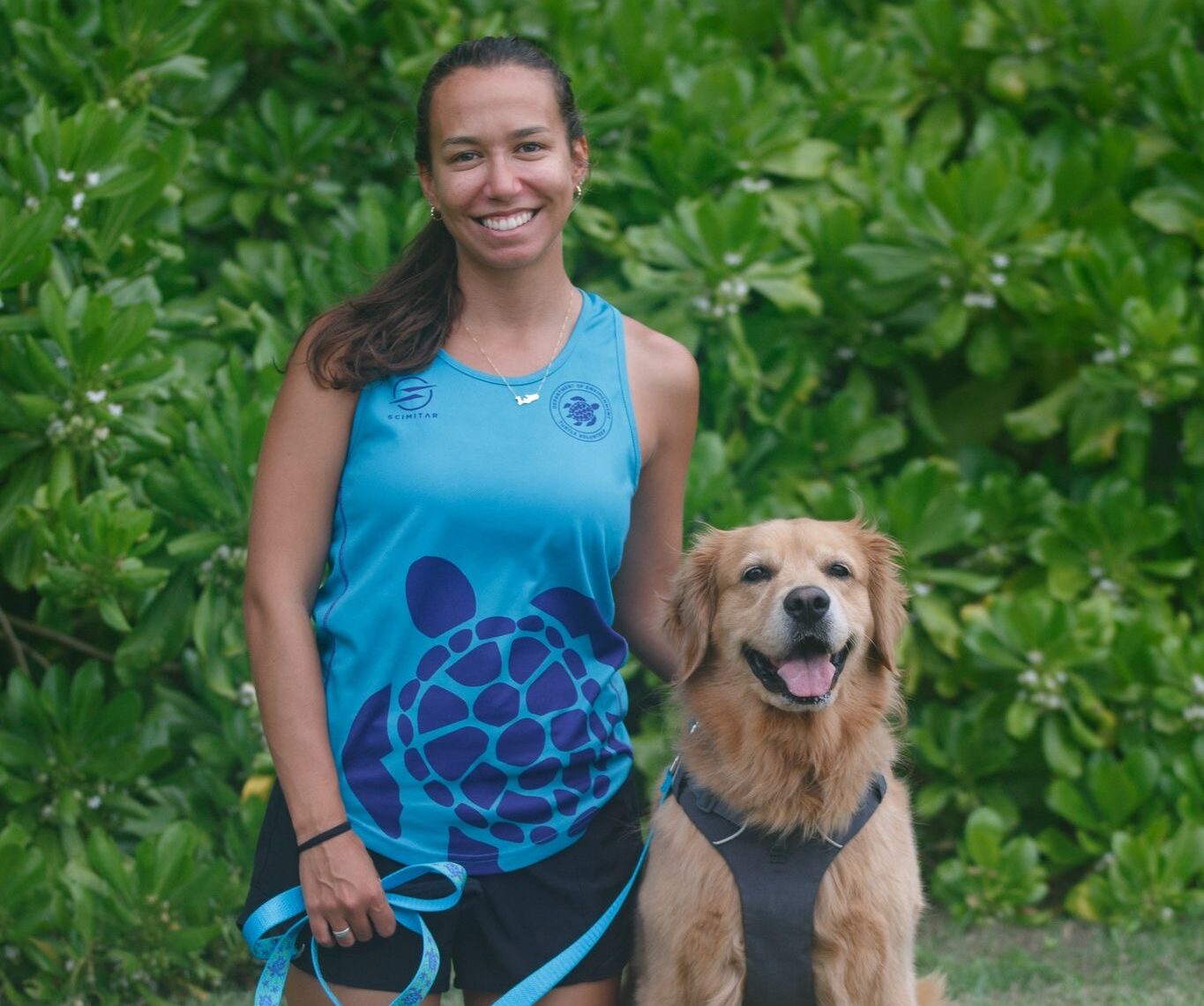
An award-winning golden retriever, Bell, is becoming Cayman’s first sea turtle detection dog. The effort is part of a pilot study by the Department of Environment and Cayman Turtle Centre to train the canine to track sea turtle hatchlings that have become disoriented due to artificial lighting.
DoE Coral Reef Management team member and part-time Turtle Team member Stephanie Gunby has spearheaded the pilot study with her 5-year-old, purebred golden retriever. The concept arose in 2022 when Gunby was wrapping up her master’s degree project in Canada and returning home to Cayman.
“I had fallen I love with dog sports and dog training, although the world of competitive dog sports doesn’t exist in Cayman,” Gunby told the Cayman Compass. “I wanted to keep up our training somehow and thought it would be a unique way for me to give back to Cayman.”
After gaining inspiration from podcasts and following various trainers, Gunby began competitive scent detection classes with Bell before moving back home.
“It wasn’t until I started doing more research that I became fully aware of the world of conservation canines and realised that the possibilities are seemingly endless when it comes to utilising dogs’ incredible noses for conservation and research,” Gunby said.
The initial idea Gunby had was to train Bell to find turtle nests on the beach and track hatchlings that have become misdirected by artificial lighting, known as a misorientation.
“Earlier this year I came across a paper that was published where a team in Florida had trained and successfully utilised a dog to find sea turtle nests on a stretch of beach over the course of a couple nesting seasons,” she said.
“I reached out to the lead author explaining that I had a similar idea and was excited to learn that this type of work had been previously successful. So, I thought, why not try it myself?”
Partnering for conservation
Bell and Gunby eventually reached a point in their training where they benefitted from extra guidance and mentorship.
Gunby reached out to DoE’s Conservation Officer Supervisor Maggie Baldino, who has a background with training and handling detection dogs. After meeting and assessing Bell, the women advanced with training.
“I brought my idea to Jane Hardwick, Sea Turtle Progamme coordinator at DoE, and was over the moon when she thought that it was as cool as I did and also that if pulled off successfully, could boost the productivity of the Turtle Team,” Gunby said.
“After a couple conversations about the best way to implement Bell on the team, we decided that tracking misoriented hatchlings would be the direction that could provide the greatest help.”
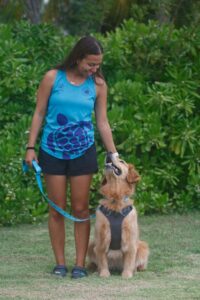
Bell is specially trained in scent introduction and imprinting, shaping the desired indication behaviour with searches for hidden scents.
The dog will eventually make the jump from training to working in the field, all while continuing to improve her skills with new challenges and troubleshooting along the way.
“There’s a lot that goes into training the dog but also a lot that goes into training yourself as a handler, especially me, a handler new to detection work. We work hard with the training to set the working dog for success but at the end of the day, it’s a partnership,” Gunby said.
“Cayman is my heritage and my home and after spending close to seven years away at university, it has always felt important to me to give back. I acquired a new skillset and genre of knowledge while abroad about dogs and dog training and felt like being able to combine that passion with my chosen career path as a marine biologist was a no-brainer.”
Gunby said conservation canines have been successfully utilised in efforts around the world, “so why not also in Cayman?”
‘A good nose’
From eight weeks old, Bell began training with Gunby as her service dog for a long-term injury.
“She’s an extremely special girl and my heart dog, and through training her, my eyes were more fully opened to the wonderful world of working dogs,” she said.
Bell has been involved in a number of dog sports, earning 12 titles in her first year competing with Gunby.
“In one of those sports, rally obedience, she finished 2022 in the top 10 ranking for her breed in Canada and top 5 ranking for her breed in Ontario,” Gunby said.
Now in Cayman, Bell’s talents are being honed by a partnership with the Cayman Turtle Centre, who is providing scent samples, and DoE’s Baldino, who has a background in detection dog training and handling.
Baldino said training a scent detection dog requires a dog who is keen to work for a reward, “responds to her handler and has a good nose.”
“Odor detection utilises positive training and the dog is rewarded for locating the scent she has been taught to find. There are many facets to this type of training, which includes finding the right methods that work for each individual dog,” Baldino said.
While all dogs have a good sense of smell, Baldino said it is important to note that not all dogs are suited for this type of work for various reasons.
Bell, a breed known for gentleness, is trained to give “a passive alert, meaning she will lay down where she has detected the odor, with her focus on the scent,” Baldino said.
The ability of odor detection dogs to focus on finding a specific scent means they can locate endangered species or detect invasive species without harming the environment, Baldino said.
“The turtles’ welfare will be of utmost concern and Bell will not pose any threat. Stephanie, her handler, can identify when Bell is ‘in the scent’ and be prepared for an imminent find,” Baldino said.
Artificial lighting threat
Marine Research Officer Jane Hardwick, a Turtle Research Project coordinator, told the Compass the new initiative will help to save more hatchlings from the anthropogenic threat of artificial lighting.
“When misdirected by lights, often more than 100 sea turtle hatchlings end up spread across a property overnight, using all their precious energy reserves,” Hardwick said.
“They have been found in drains, swimming pools, gaps under walls, in roads, in brushes, crab holes, etc. It can be extremely difficult to locate them and release them before they perish, and therefore, using a detection dog should increase the number of hatchlings we are able to save.”
To date, the DoE has recorded 120 nests this season across the Cayman Islands with the first nests now beginning to hatch.
If you see any turtle activity, please send a WhatsApp message to DoE’s 24-hour Turtle Hotline on 938-NEST (938-6378).
Related Videos