

A diver was bitten by a shark off Little Cayman on Friday evening, 6 Feb. The bite was described as ‘exploratory’ and resulted in relatively minor puncture wounds, however because there are no full-time doctors based on Little Cayman, the individual was flown to Grand Cayman for treatment.
“The incident occurred while researchers were in the water documenting the annual aggregation of Nassau groupers, which gather off the western tip of Little Cayman after the full moon in February to spawn,” said Peter Hillenbrand, a resident of Little Cayman.
“Berkley White, a photographer from Backscatter Underwater Video and Photography based in California, was using a scooter with a video camera on the front of it to document the groupers and he was bitten on the thigh.”
Hillenbrand added that the incident occurred after the sun went down, when there were only three or four scientists still in the water documenting the aggregation of the fish.
“His life was not in jeopardy; however everyone got back on the Sea Keeper dive boat quickly, the government nurse Charmaine Coore was waiting at the Little Cayman Beach Resort when the vessel arrived and he was treated immediately,” Hillenbrand said.
“The nurse treated the wound, however because there is only a small clinic on Little Cayman, she recommended that White should go to the hospital, so the RCIPS helicopter landed at the Edward Bodden airfield and flew White back to Grand Cayman, where he was provided with further treatment at the George Town hospital.”

– Photo: Lolita Bodden
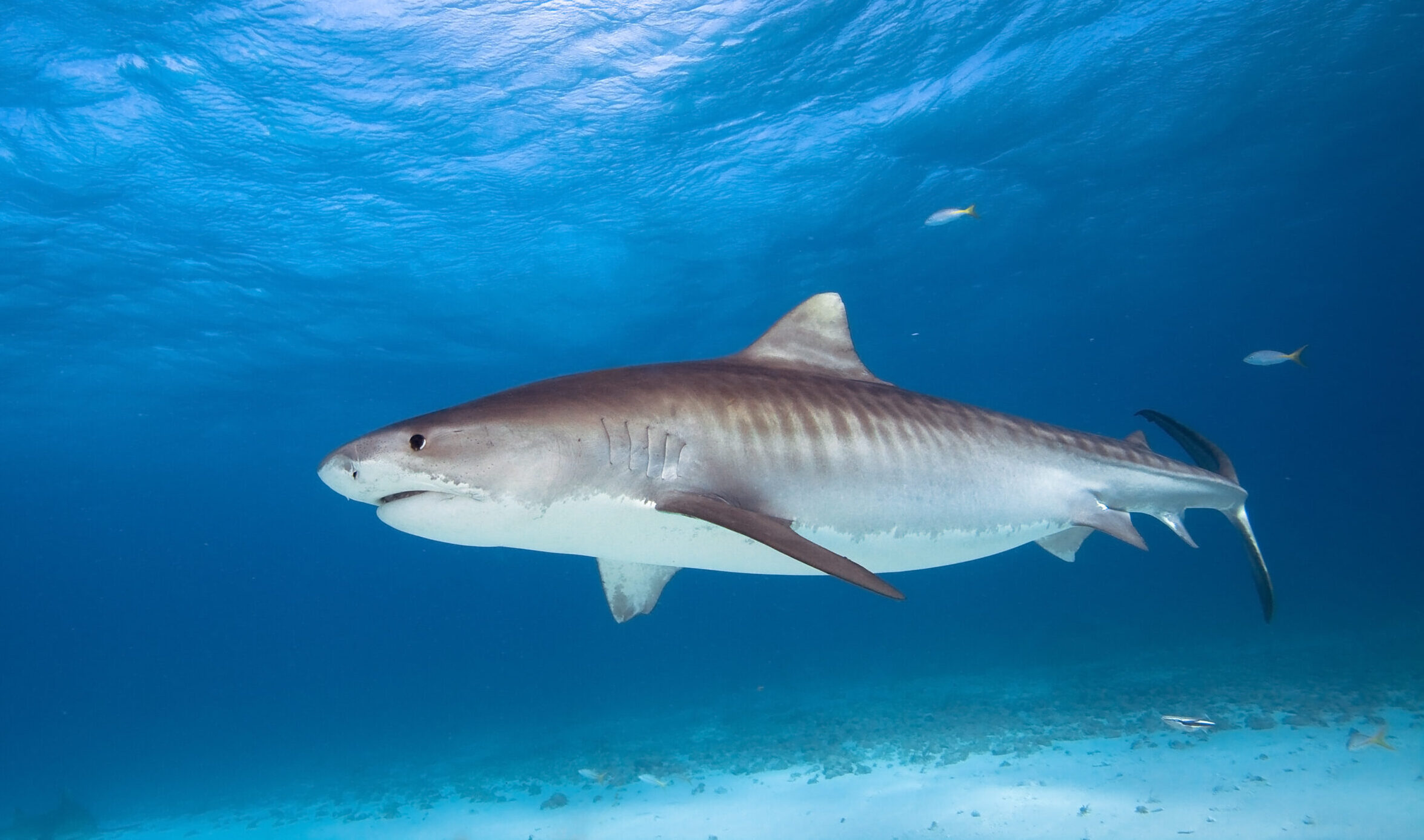
On Sunday, the Department of Environment issued a press release, in which they stated that it was a juvenile tiger shark, approximately 7 feet long, that was responsible for the bite.
The gathering of so many groupers in a small area is known attract some sharks to the site at this time of year, in particular reef sharks. However, in the past there have been no incidents between the sharks and the researchers.
Shark attacks are extremely rare in the Cayman Islands.
In a statement, the spokesperson for the Department of Environment said, “While this incident was not expected, it is natural for sharks to be attracted to the activity of an aggregation site, and a young shark is less likely to have experience with groupers and divers. Coupled with the poor visibility of the site, the young shark mistakenly bit the diver but since sharks do not consider humans food, it fled and did not pursue.”
The grouper aggregation occurs in early February each year, following the full moon. Thousands of endangered Nassau groupers come together to spawn at the site in Little Cayman and researchers from the Reef Environmental Education Foundation, known as REEF, the Cayman Islands Department of Environment and scientists from Scripps Institution of Oceanography and Oregon State University have been studying the spawning phenomenon and tracking the number of fish.
When scientists began studying the grouper spawning site back in 2001, there were only about 1,500 groupers. Government later established legal protections on the aggregation sites, banning fishing in the areas during the spawning cycles.
As a result of the protections, Nassau grouper populations on Little Cayman and Cayman Brac rebounded significantly over the past two decades, making the Cayman Islands a regional leader in grouper conservation.
Related Videos









Glad he’s ok. Many divers (including me) dive with sharks every day around the islands and this is the first bite I’ve ever heard of. So yes, extremely rare. Tigers are also quite rare here. Never seen one in Cayman waters. By the way, I don’t think the picture in the article is of tiger sharks. Tigers are so named because of their stripes. Maybe it’s just a stock photo of sharks.