

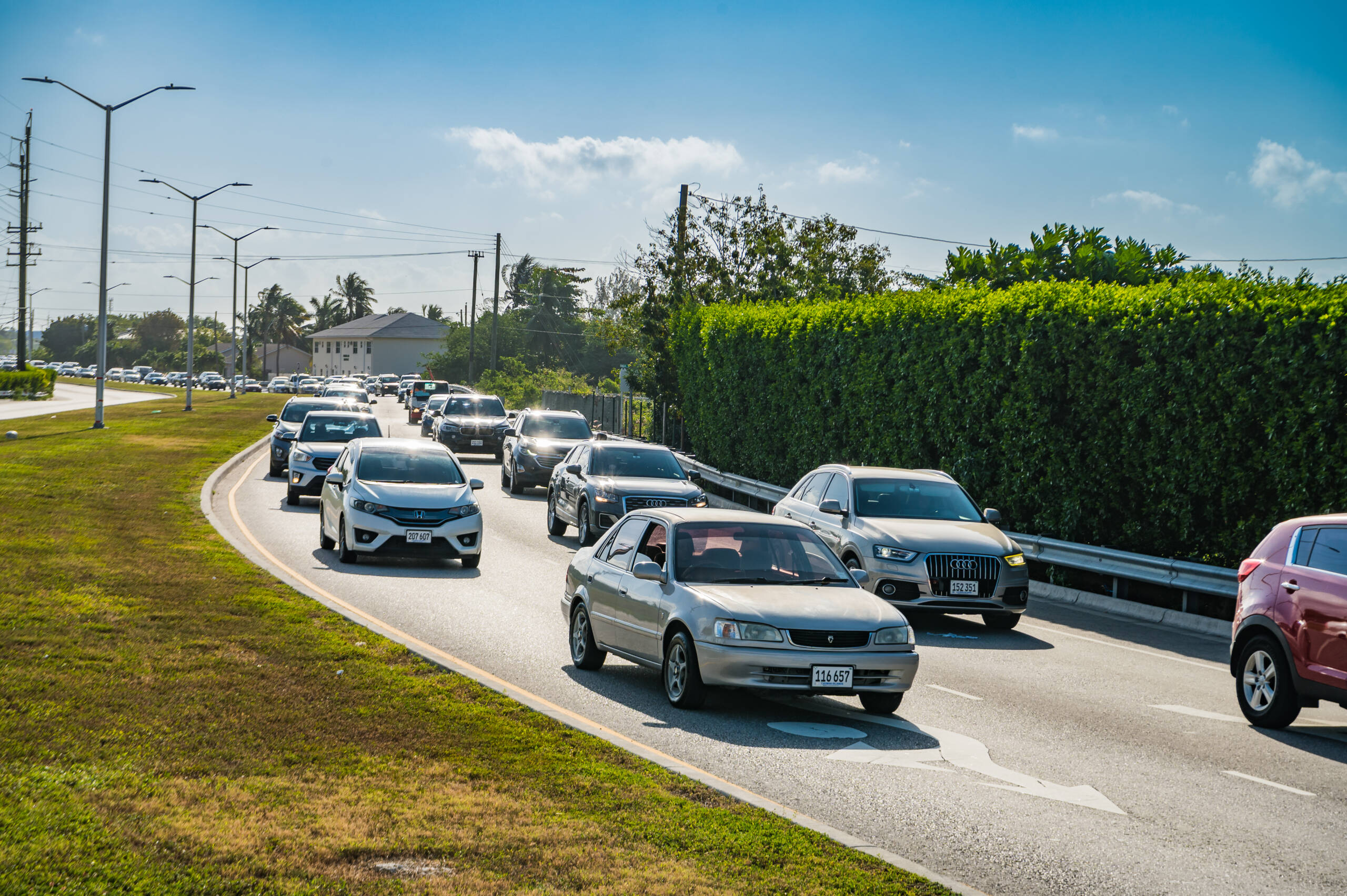
In the meagre shade outside a Subway store, a middle-aged woman with conspicuous sunscreen was struggling to access Wi-Fi on her smart phone.
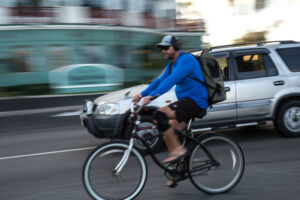
She had attempted to travel by bicycle from the Botanic Park to George Town and found the traffic and the weather too hot to handle.
After waiting by the side of the road for a while, a bus had stopped en-route to the capital, but the driver couldn’t accommodate her bike.
So, she was now sheltering in the Countryside Shopping Village, trying to connect to the Internet to look up a number for a taxi. I lent her my cell phone, which has data access, and after three attempts we found a cab that would collect her, with a surcharge added for the bike.
The woman, a visitor from the US, ultimately got where she needed to go, but she was unlikely to try travelling in Cayman again without a rental car.
One simple Saturday journey had aptly illustrated the absence of key supporting infrastructure that makes journeys by foot, bike or bus possible in many other places around the world.
No bike lanes, no shaded sidewalks, only small minibuses operating inconsistent routes, a lack of Wi-Fi hotspots or low-cost data plans to summon a cab and affordability challenges when the taxi does arrive. In the space of a few hours, she seemed to have encountered almost every major obstacle Cayman commuters have been facing for decades. As the island’s population and traffic problems have grown, the absence of reliable alternatives has become glaring.
Traffic a key culprit in carbon emissions
The previous morning, I was part of a radio show, discussing possible solutions and adaptions to the climate threats facing Cayman in the coming decade – the subject of the project that the Compass Issues section is currently engaged in.
My namesake, James Whittaker, the chairman of the Energy Council, made the point that Cayman, on a per-capita basis is one of the worst polluters in the world.
Our rush hour traffic is one of the key reasons for that.
We tried to end the show on a positive note, talking about small things we could change as individuals that might help alter the depressing portrait that the United Nations and others are painting of the world and the island’s future.
But the discussion quickly circled back to the fact that so much of the enabling infrastructure that allows people to make good choices – such as leave their cars at home – does not yet exist in the Cayman Islands.
Related stories
While pollution from cars is an obvious connection between traffic and climate change, we hadn’t immediately thought of a transport discussion as something that automatically fits in as part of this series.
Cayman’s ability to impact global emissions targets is negligible and our aim here is to examine solutions that can make the island more resilient in the face of threats like sea-level rise and super storms, which the UN warns are practically inevitable.
Because it intersects with so many other issues, from quality of life and mental health to housing affordability and work opportunities, the impact of a proper public transport system in ‘climate-proofing’ Cayman can sometimes get lost in the mix.
A new perspective
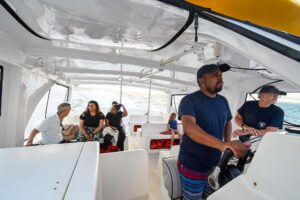
Cruising through the calm waters of the mangrove fringed canal system on the first commuter ferry from Newlands to Camana Bay last week, those impacts started to come into focus.
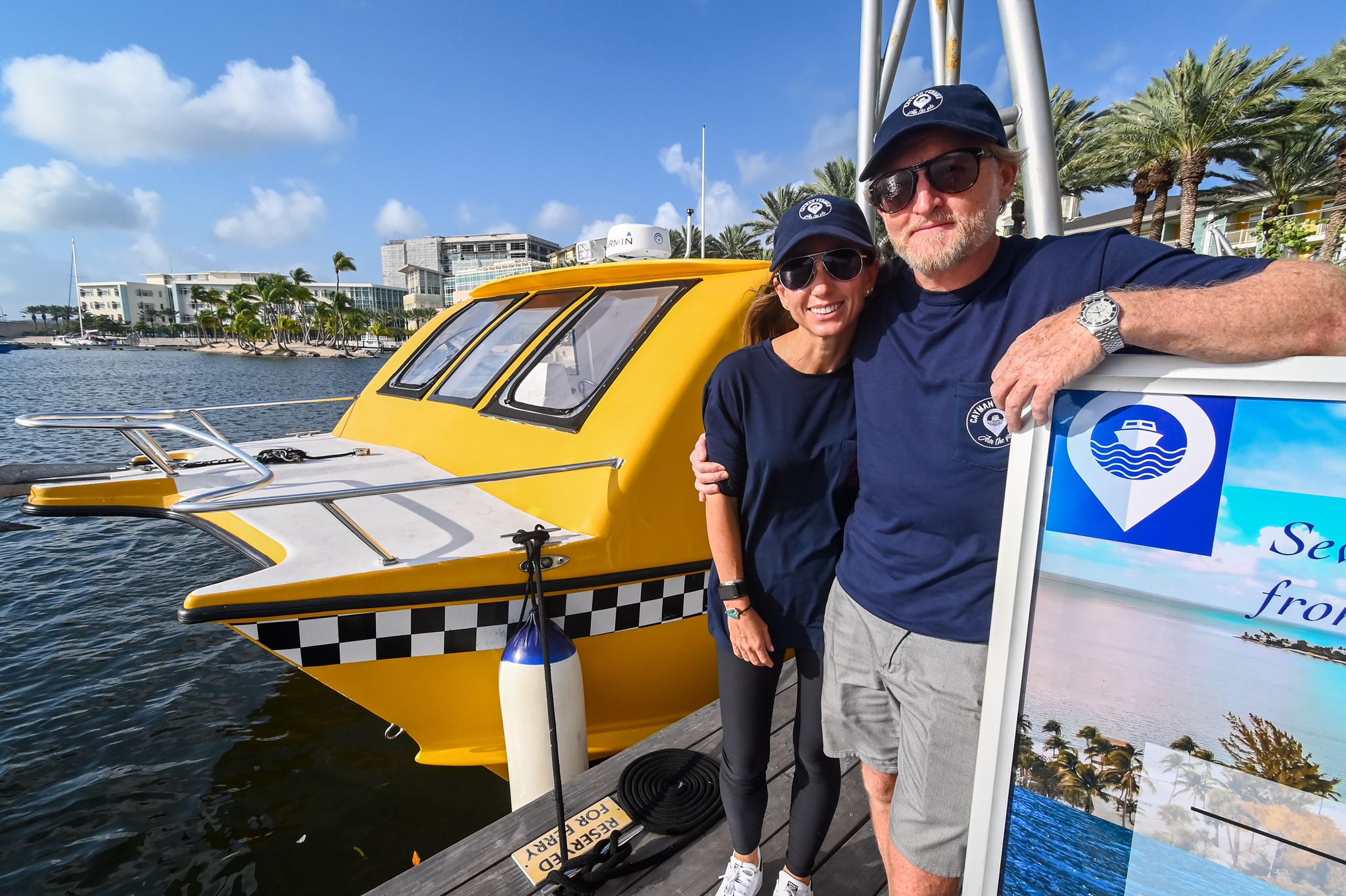
Claire Pettinati and her husband Daniel Petts started Cayman Ferries primarily as a means to allow those who commute from anywhere east of Grand Harbour to take a more refreshing route to work.
Pettinati first wrote about her vision of a sustainable national transport system as part of our Cayman 2.0 series in 2020, when we challenged readers, during the pause in normal life caused by COVID-19, to present big ideas that could help the country come back a stronger, better place.
She wasn’t content just to dream.
The couple bought a boat, established a ticketing app and the first commuters began using the service last week.
“We wanted to make a difference and change things up, rather than just talking about it,” she said.
The business is in the process of registering as a “non-profit” meaning all proceeds will be reinvested in expanding and developing a transport system based around the North Sound. On a longer time scale, with more investment, she believes stops could be added at other docks and links established with buses and other providers.
“We would like the ferry to be a transport hub that helps people get around the island in a sustainable way,” she said.
“Cayman is such a beautiful place to live and it is such a shame that so many people sit in traffic for three hours every day,” she said.
There are challenges to making the ferry system, in its current form, accessible to everyone. But those on board its inaugural trip, appreciated the sun on their face and the wind in their hair as a contrast to the normal morning commute.
“Just being able to take in this view and knowing that there are no cars in front of me causing traffic is really exciting,” Ariel Thompson, who lives in Newlands and works in Camana Bay, told us.
Roads and development threaten mangroves
One enthusiastic passenger who joined the ride was Martin Keeley, founder of the Mangrove Rangers. He explained, animatedly, why he believes transport solutions like the new ferry are an important climate resilience tool.
He said the idea of an integrated public transport system had been discussed for nearly 50 years without any concerted action.
Meanwhile, he has seen roads go up, new subdivisions go in, landlocked parcels open up for development and Cayman’s mangroves continue to disappear.
The islands’ first set of ‘natural capital accounts’ finalised last month puts the partial value of mangroves at over $1 billion because of the ‘services’ they provide, including capturing carbon from the atmosphere and providing natural defences against storm surge and flooding.
Yet those habitats remain vulnerable to infrastructure development.
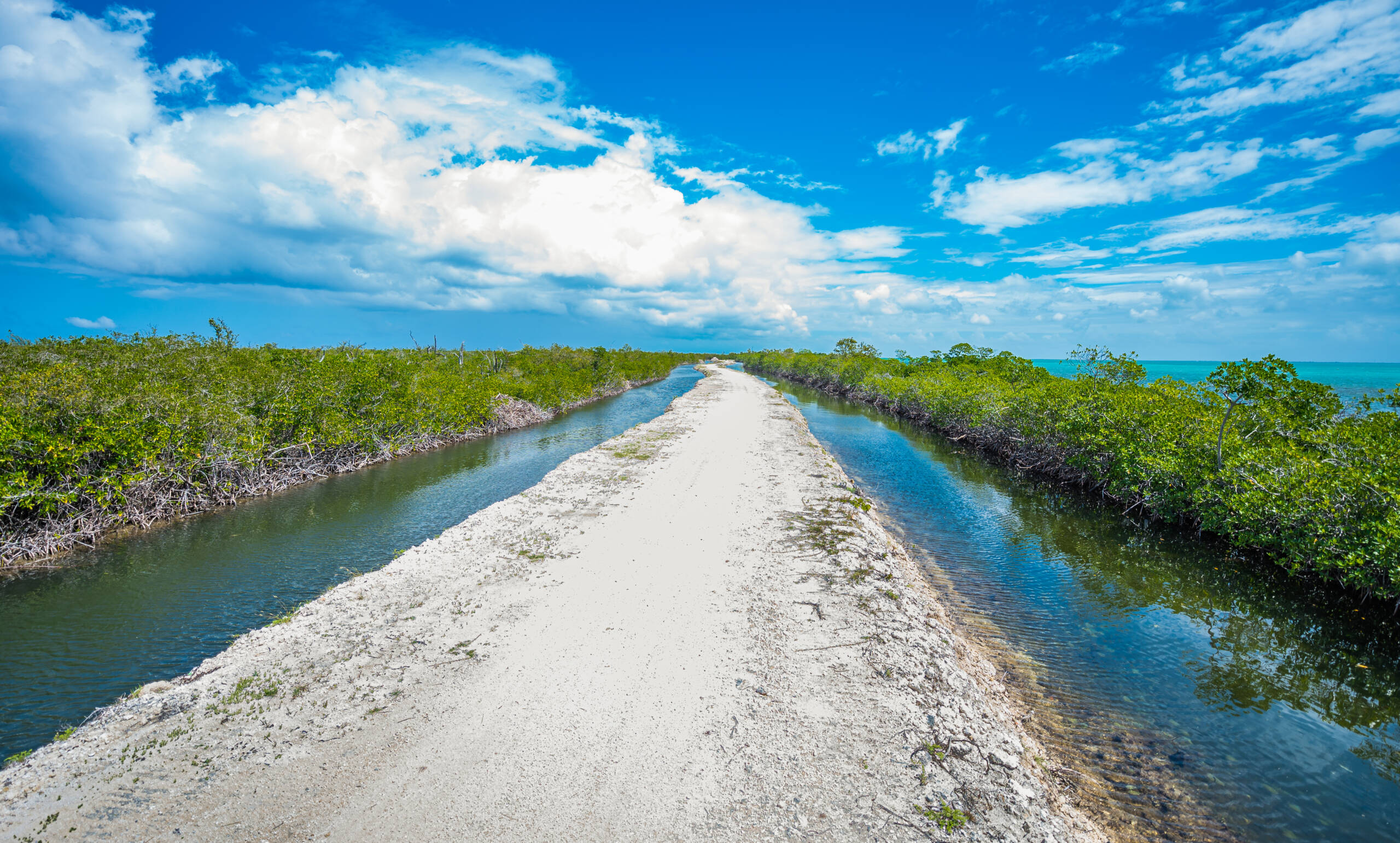
The latest plan – to push ahead with an extension to the East-West Arterial – has been touted by government as part of its solution to traffic challenges.
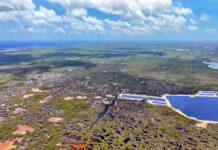
And while an Environmental Impact Assessment has been promised, the current route of the proposed road intersects the Central Mangrove Wetlands.
Keeley is unconvinced the highway will make much difference to journey times from the eastern districts to George Town and is concerned that it will only open up more land for development. The impact will spiral outwards from the road, he warns, with previously landlocked parcels now ripe for businesses and homes.
The National Roads Authority wasn’t available for comment.
The National Trust and the Department of Environment have highlighted serious concerns about the potential ecological impact of routing a highway through the wetlands, cautioning it could act as a dam that exacerbates storm surge and other climate related impacts.
What happened to Cayman 2.0?
Keeley argues that Cayman needs to find more innovative solutions than new highways and lane extensions.
“As the old saying goes, if you build it, they will come and if you build it, they will drive on it. This approach is destroying the island, not just through emissions from traffic, but you’re destroying the habitat.”
He believes COVID showed how quickly society can change in the face of an imminent threat. But climate change, by contrast, is a slow moving disaster that he believes people are complacent about.
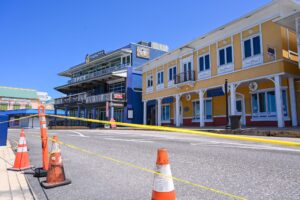
It concerns him, how quickly the positive aspects of life in lockdown – the work from home movement, the appreciation of nature and traffic free roads – appear to have been abandoned in the rush to get back to business.
“We need to reboot, reset and rethink what we’re doing,” he said.
“That’s what happened in COVID. And then what did we do? We went right back to square one. So the lessons that we learned, we toss those out the window, and the so called new normal is just like the old normal.”
Beyond road building
Almost everyone who has looked at Cayman’s traffic issues has made the same point.
As former infrastructure minister, Joey Hew cautioned in 2017, “We can only build so many roads”.
Hew helped bring in the ‘complete streets’ initiative – which involves an attempt to create more cycle lanes – and was instrumental in assembling the Strategic Economic Advisory Council – a think-tank of public and private sector leaders that looked at ways to reboot Cayman post-COVID.
Cayman Islands Tourism Association president Marc Langevin, was one of the leaders of a tourism sector team on that initiative, that also involved Pilar Bush, formerly of Dart and now chief of strategy in the Office of the Premier, Bill Edwards, of Red Sail watersports and Kenrick Webster of Webster’s Tours, among others.
Their number one recommendation was the creation of a Cayman Transit Company that would operate a new and improved public transport system.
Langevin told the Compass that the absence of reliable transport was one of the key obstacles for workers living anywhere east of George Town to take jobs at hotels in the Seven Mile Beach area.
He said it was impossible to work in tourism and not own a car – an expense many employees would prefer to avoid if there were alternatives.
“We keep adding one more lane, one more lane, but we are not addressing the problem,” he said.
Webster suggests new lanes should be dedicated as ‘bus only’ to provide the incentive needed to get people out of their cars.
Despite the apparent consensus, the only concrete policies on traffic to have materialised so far, involve more roads and more concrete.
Kenneth Bryan, who took over the transport brief after the general election last May, has indicated he would like to see a better bus system. His ministry has gone out to tender for consultants to assist with a plan for the island. But he cautioned it would be a long-term process and other policy interventions may be needed for people to ditch their cars.
‘Test and learn’
Paul Henry understands that challenge better than most. As head of business innovation at Dart Labs, he has organised numerous alternative transport systems and polices for Camana Bay workers with a “test and learn” philosophy.
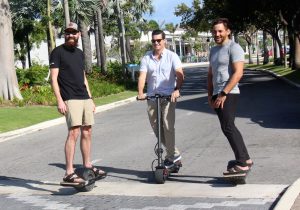
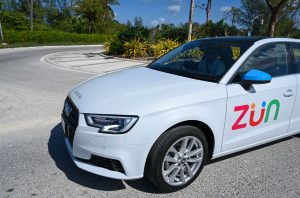
Easy-to-rent bikes and motorised scooters for short journeys, a partnership with Audi to introduce ‘Zun’ cars that rent by the minute and a ride-share app were all trialled with varying degrees of success.
“There is no silver bullet. Any solution is going to have to have multiple elements to it,” he said.
The new ferry may be a case in point. While it was smooth sailing for commuters heading to Camana Bay. Those who work further afield faced challenges with the onward journey.
Pettinati says Cayman Ferries is working on partnerships to change that dynamic.
And she hopes to add features to the app that will allow commuters to link to other initiatives, like the Zun car rental system or the Bird electric scooters.
Henry highlights the UK’s ‘Citymapper’ system as an example of a transit app that functions as a booking, timetable and information hub for multiple different modes of transport.
The carrot and the stick
While he believes there is promise in many of these emerging ideas, he cautions there are challenges around scalability and integration.
The Zun car system suffers because it has a limited number of vehicles and a limited number of collection and drop-off points. The ferry suffers because it only gets you as far as the water’s edge. Bike rental falls down because of lack of cycle-ways to make riding safe.
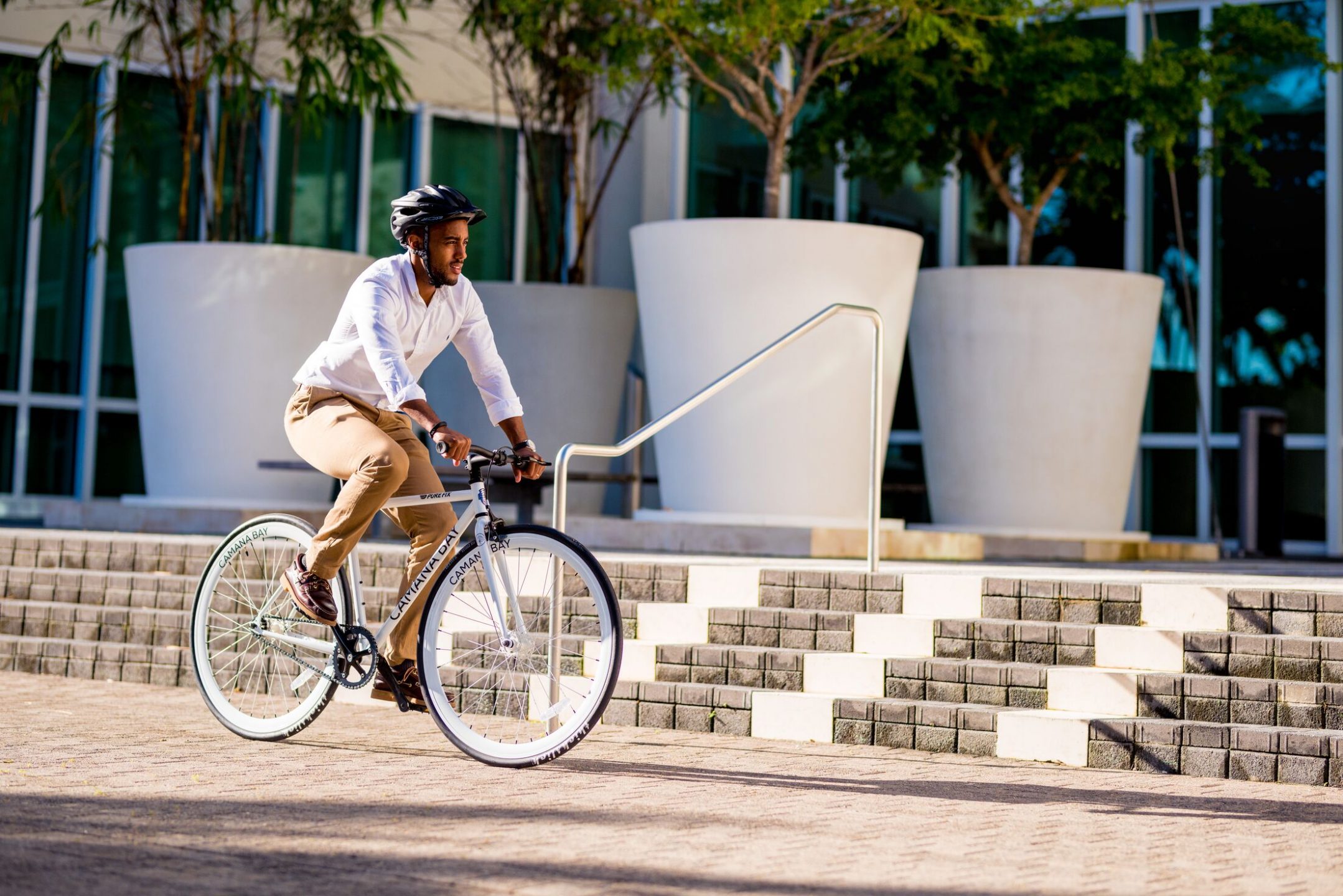
Again, the enabling infrastructure is lacking.
Any solution that moves Cayman beyond building roads will need to be a well-managed and innovative mix of new ideas, bringing together multiple operators and modes of travel, Henry believes.
Even then, he warns, there may be a cultural challenge with persuading people to leave their cars at home.
One of the least successful initiatives tested by Dart Labs was an incentivised carpooling scheme, where Camana Bay workers were offered generous discount points at town centre stores if they shared rides to and from the office.
“It just didn’t work,” Henry acknowledged, noting that people were reluctant to give up the flexibility of having their vehicle on standby throughout the day.
Given the reluctance to adopt incentive-based systems to date, he wonders if the “stick” of pay-and-display parking across Grand Cayman or congestion zoning may be more powerful than the “carrot” of rewards for sharing rides. The income could then be redirected towards environmental initiatives.
Abundant free parking and the lack of restrictions on vehicle use in Cayman already incentivise car travel to a level that is not common in other countries.
“It is a complex problem and we don’t have great precedents in similar environments to look at,” he said.
“The introduction of parking restrictions and fees have been effective elsewhere in encouraging vehicle sharing and the use of alternative transport, but it is difficult to burden road users with that when there is no accessible alternatives.”
Related Videos









Singapore has no traffic – it’s population density is 20,000 people per square mile – the equivalent of us having 2 million people. Their subway system is beautiful – clean, safe, and cheap.
There should be an incentive for parents who send their kids to school on a school bus If not that, then a disincentive such as a hefty fee to drive your child to school in the morning. All those thousands of extra cars on the road each morning when Mom takes the kids to school and Dad drives to work in the second car!
• Start by not allowing construction trucks/delivery drivers on the road during the morning and evening rush hour.
• Construction companies to pay an emissions duty if they do use heavy goods vehicles during peak hours.
• Paid incentive for carpooling.
• Let the fee-paying schools use the yellow school busses, as some appear to be half full.
• Encourage the fee-paying schools to provide a school bus service.
Stop trying to impose London or UK fixes which don’t work there over here. In London congestion charges are a tax grab and they work for Government there because there are lots of people to tax. Here they would be an annoyance and wouldn’t bring enough revenues to offset their administration, and importantly they wouldn’t solve the traffic. Unfortunately we are going to need a few more cross roads to link existing arterials here. We should build them faster — and Yes, we need a bypass to allow folks to move East easier. When I first came to Cayman 21 years ago I asked my Caymanian neighbor if I would need to buy a car and he gently smiled and said: “My boy, they don’t call it ‘Grand’ Cayman’ for nothing”. I bought a car and became part of the problem the next day. If Government really wants to fix traffic, let Uber in here. Make them be Caymanian drivers at first. Uber works!