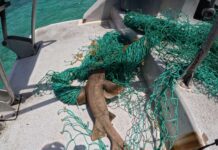
A George Town fisherman found three dead sharks entangled in a large abandoned fishing net about a mile off the west coast of Grand Cayman earlier this week.
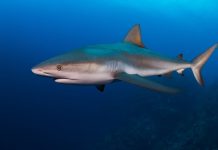
On towing the net back to shore, two of the sharks came loose, but the remaining one was later identified as a Caribbean sharpnose shark – a rare species that is declining in numbers.
Charles Ebanks, who has fished in Cayman waters for 38 years, told the Compass that he discovered the estimated 150-foot long net on Sunday morning, 26 March.
“It was all tangled up in a mess and then there was a piece of it hanging down in the water that was kind of open and free,” he said, “and from the surface I could see three sharks.”
‘It just takes one person’
The fisherman immediately called the Department of Environment to alert them of his discovery, before spending the next two hours towing the net to shore.

As well as the shark, there were also dead fish and crustaceans trapped in the net.
Ebanks said it is important to remove these plastic nets, which likely come from large commercial fishing boats, because they kill many species of fish and sharks.
“I can’t save the world but it just takes that one person or anyone to help out and if I can in anyway at all I will,” he said, adding that he is a conservationist alongside a fisherman.
It was the third time Ebanks found an abandoned fishing net in the area – the last was in 2018 when he spotted a huge net about three miles off Rum Point.
He towed the net, thought to contain many dozens of dead fish and sharks, to Harbour House Marina.
Caribbean sharpnose shark (Rhizoprionodon porosus) can be found in the tropical West Atlantic, Caribbean and South America.
Risk of extinction
The species has undergone an overall population reduction of 30 to 49 percent over the past three generations (14 years), according to the IUCN Red List, 2023.
It is vulnerable, and considered to be facing a high risk of extinction in the wild.
Dr Johanna Kohler, shark project officer for the Department of Environment, explained that the shark is an offshore species that would not normally be found around Cayman’s reefs.
While it could be mistaken for a juvenile Caribbean reef shark, the adult Caribbean sharpnose shark has distinct differences in its fins, eyes, snout and patterning.

Kohler stressed the importance of recovering discarded fishing equipment, and added that fishermen and women should dispose of their equipment appropriately.
“We believe it was a gillnet that either got lost or was disposed of – we don’t know what the intentions were behind it,” she told the Compass.
“But either way, the point is that we don’t pollute, because endangered wildlife can be caught.”
Gillnets are vertical panels of netting that hang from a line suspended by floaters. The nets trap fish by the gills, preventing them from escape.
If anyone sees a net in Cayman waters they can call the Department of Environment’s Conservation Unit on 916-4271.
Related Videos