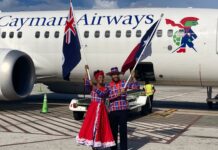
Cayman Airways has reissued its tender to secure a third Twin Otter aircraft for the Little Cayman route after its first request for proposal was not successful.
News of the re-tender has left Sister Islands Tourism Association president Peter Quilliam upset as he had been looking forward to a resolution to airlift woes on the Little Cayman route.
“We understand that Cayman Airways are doing the best they can, but to hear that there are yet again more delays in the acquisition of the promised and sorely needed third Twin Otter to service Little Cayman, is of course disappointing,” Quilliam said in an emailed comment to Cayman Compass Wednesday on the re-tender.
Quilliam said SITA, as well as the residents and tourists coming to the Sister Islands, “would very much love to have the third Otter in the fleet as soon as possible, and implore the team at Cayman Airways to do everything in their power to make this a reality. Perhaps even a Christmas present this year?”
However, it is yet to be seen if that wish will come true.
The Cayman Airways re-tender, which was issued earlier this month on government’s Bonfire procurement portal and ends 15 Nov., has an anticipated execution of agreement timeline of February 2024.
In May, the national flag carrier had invited bids as it sought to purchase or lease “a suitable de Havilland DHC-6-300 aircraft”.
A Cayman Airways spokesperson, following Cayman Compass queries on this month’s re-tender, explained that, “due to very limited availability in the market at the time of the first tender, it was unsuccessful in sourcing an aircraft that meets our technical requirements and operational needs”.
However, the spokesperson said with the new tender there is some availability of potentially suitable aircraft on the market.
“We are therefore optimistic that this second round of public tendering will lead to an acquisition,” the spokesperson said via email.
The airline has two Twin Otter planes in service. In December last year, Tourism Minister Kenneth Bryan promised that a third prop plane would be acquired.
His promise came on the heels of challenges with inter-island travel for Cayman Brac and Little Cayman last November when tourists had to be ferried between the two Sister Islands on dive boats when both Twin Otter planes were out of action.
The current Twin Otter operations in the meantime have been operating without complaint.
The Cayman Airways spokesperson said it is currently the typical slow season for travel so “this is the time of year when the airline would have one Twin Otter at a time (both in sequence), away on annual heavy maintenance, until the end of November”.
“This annual heavy maintenance is required to ensure that we continue to maintain our exceptional safety record, which our passengers expect and trust,” the spokesperson said.
No impact on service
From a flight schedule perspective, the spokesperson added, “this has not impacted our Little Cayman operations so far this season”.
However, Quilliam said with one Otter out for service, due to routine maintenance, it leaves the community with only one plane capable to fly into the Little Cayman airport.
“We are at the mercy of mechanical breakdowns as we launch into our busy season, leaving us with no airlift at all. Sadly this happened last Sunday stranding families on Little Cayman overnight. Flight schedules didn’t get under way until early afternoon the next day,” he said.
The Cayman Airways spokesperson said that when a third Twin Otter is acquired and in service the airline can then look forward to some expansion of that service to and from Little Cayman “on the weekends and on high demand days, with much better redundancy whenever one of the Twin Otter aircraft has to be removed from service for required maintenance”.
According to the re-tender documents, the national flag carrier is seeking one used de Havilland/Viking DHC6-300 (or -100/200 HG) Twin Otter with fewer than 30,000 total flight hours and fewer than 30,000 total flights.
The aircraft must have a passenger air stair with large entry door and additional cabin emergency exits, extended (long nose) cargo/baggage compartment and tricycle landing gear for runway use, meaning a non-amphibious or non-seaplane configuration.
The passenger capacity must be between 17 and 19 seats.
The aircraft must not have any heavy maintenance on engines or airframe due within 12 months of utilisation after delivery and must have a maximum take-off weight of 12,500 lbs, among other technical specifications.
Related Videos