

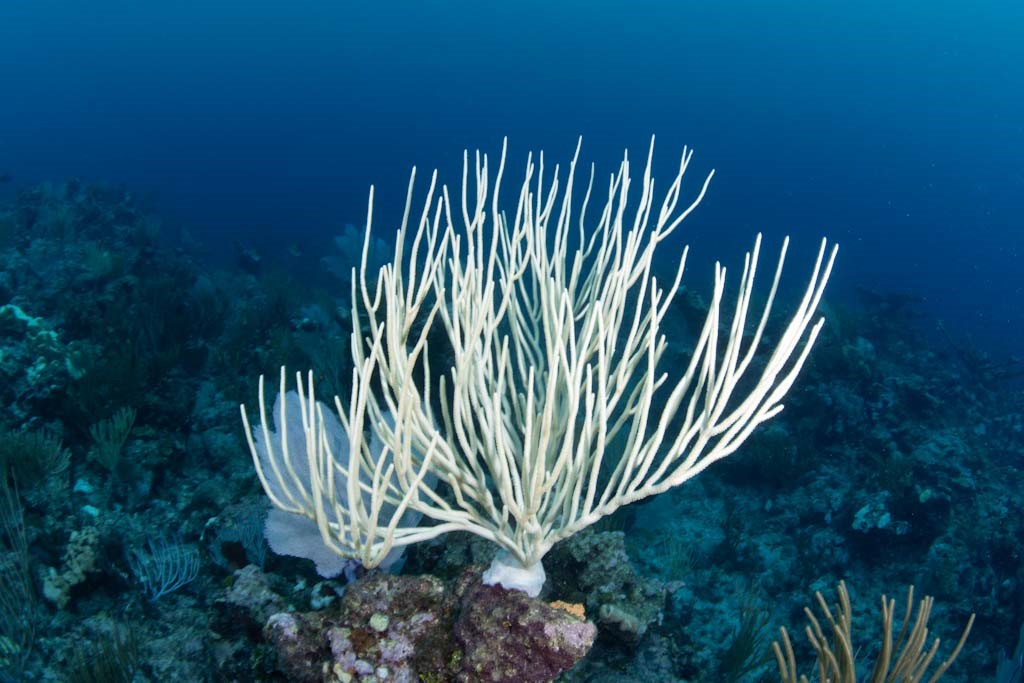
Divers on Cayman’s reefs throughout several months last year, expecting to see colourful corals, instead encountered reefs filled with white patches as far as the eye could see, as the longest recorded local coral bleaching event took hold.
Only it wasn’t just local. The same was being seen – and still is – around the world, from Australia’s Great Barrier Reef to the Red Sea in the Middle East to the coastlines of South America.
In mid-April, the US National Oceanic and Atmospheric Administration declared that the planet is currently experiencing a global coral bleaching event – the fourth on record and the second in the last decade.
According to NOAA’s Coral Reef Watch, since February last year, “bleaching-level heat stress”, has been, and continues to be, extensive across every ocean on the planet, apart from the Arctic.
Here in Cayman, the Department of Environment has been monitoring sea temperatures and their impacts on the reef for decades.
Croy McCoy, who manages the DoE’s Marine Resources Unit, has spent a lot of time in and on local waters, as a scuba diver and scientist born and bred in Cayman. What he has seen in his years observing the reefs, both professionally and recreationally, has saddened him, he admits.
“I’ve been diving across all three islands for the past 40 years,” he said. “What I see now, it’s almost heartbreaking.”
But he’s not without hope. He feels efforts being made worldwide to tackle the problem will one day pay dividends.
“It took a while to get here, and it’s going to take a long time to get out of it,” he says.
McCoy, who has a PhD in ocean sciences, describes the corals as “the canary in the coal mine” when it comes to global warming and rising sea temperatures. (Miners used to take caged canaries into mines with them as early warning mechanisms to check if dangerous gases had leaked into the air.)
Observing the decline in the health of reefs is not just the purview of scientists and researchers. Divers, snorkellers and swimmers, especially those who have been taking a dip in the local waters over several years, cannot have helped but notice the change.
In bad shape
Pablo Cantos Arévalo, a dive instructor at Sunset House, says the reefs he and the dive operation’s customers see every day are in noticeably bad shape right now.
“This year’s bleaching hasn’t started yet, but the corals are still suffering the consequences from last year’s bleaching and from February’s nor’wester,” he told the Compass. “A lot of them are dying or dead. The algae covering them is a sign that they’ve died. Algae only grows on dead corals.
“The reefs are in a really bad situation at the moment, and it doesn’t look like it’s going to get any better as the next few months are just going to get hotter.”
Corals that grow in shallower waters, like staghorns and elkhorns, are “gone”, he said, as they are often more impacted by warm sea surface temperatures than corals in deeper water.
He noted that the local water temperatures “never really got cold, except only for maybe one-and-a-half months”, after last year’s record heat.
“It’s already 82 degrees in the water,” he said, when he spoke to the Compass at the end of April. “Between here and Africa, it’s 85 degrees. It’s going to be another bad summer for the corals. I’m fearing the worst, to be honest. They’re already struggling, and there’s more coming.”
The warming ocean temperatures expected this year, as well as a switch from El Niño to La Niña conditions, has led weather forecasters to predict a very busy hurricane season – yet another threat to the coral reefs that absorb the majority of forces from storms.
Researchers from Colorado State University have forecast 11 hurricanes this season.
Longer and hotter bleaching events
Coral bleaching has been recorded for decades, and is nothing new. But what is new is the frequency and length of the bleaching events, which, on top of the many other stressors impacting the corals, leaves them more vulnerable than ever.
In Cayman and Florida, and across much of the region, stony coral tissue loss disease hit hard in recent years, in many cases fatally targeting up to 25 different species of hard corals, like the boulder and brain corals that form the foundations of the reefs.
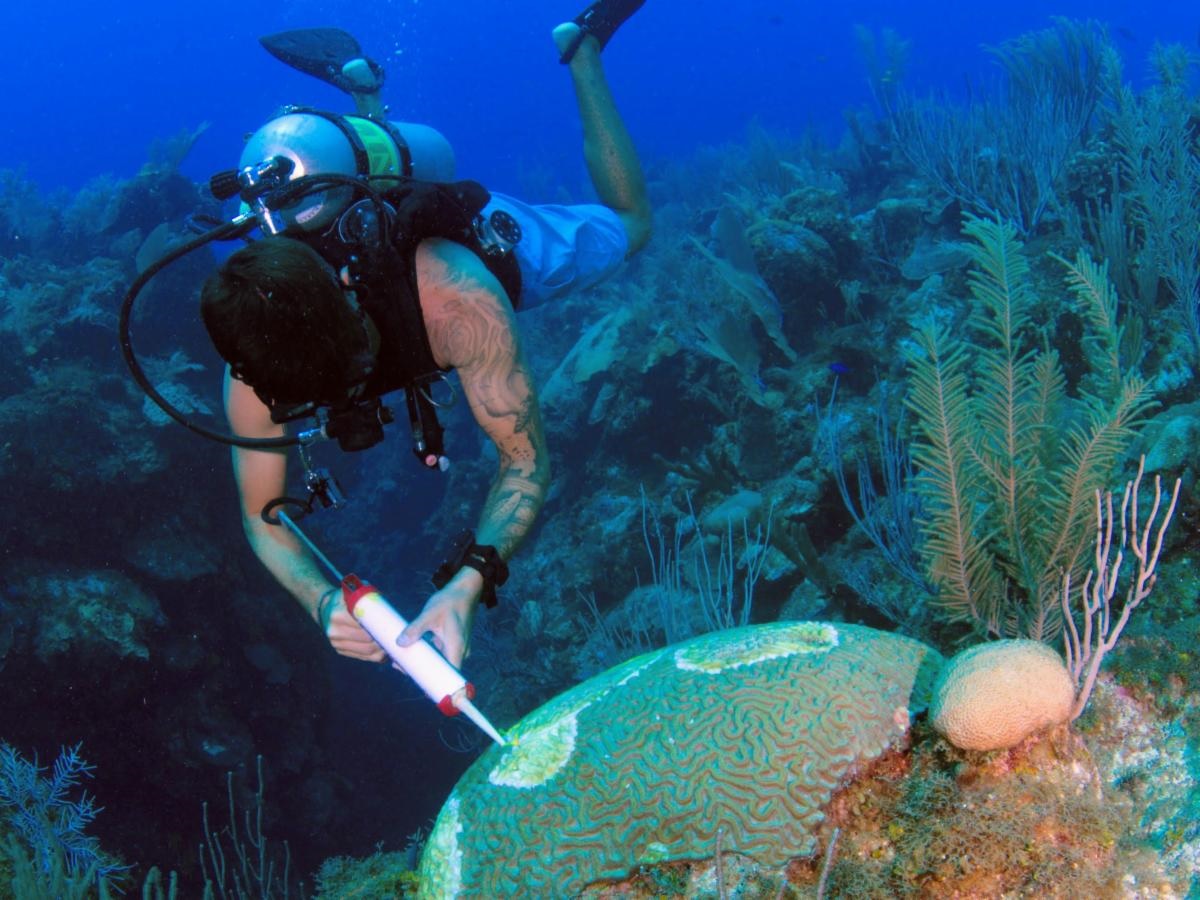
Some were saved through the use of antibiotics that divers would place around the telltale fast-moving white circular lesions on the affected corals, but the disease had a devastating effect.
This, followed by an unprecedentedly long bleaching event last year, means the reefs will not have had much time to recover before the next anticipated bleaching event hits.
McCoy compares this to a human with malnutrition, or whose immunity is compromised, or who had been badly injured, being hit with an infection or another injury before they’ve had a chance to get better or build up their strength.
“It’s not one thing that kills you,” he says. “It’s an amalgamation of events. So, when we say we need to reduce the stress on the reef, we mean each and every little bit counts.”
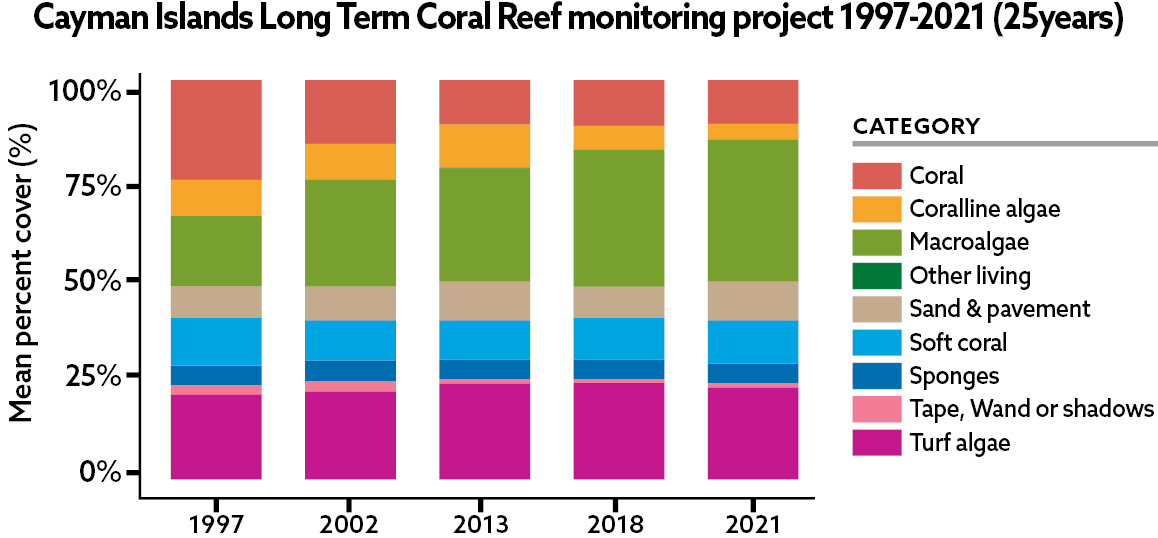
According to records, in 1994, coral coverage in Grand Cayman’s shallower reefs was 29%, while at deeper depths, it was 33%.
Three decades later, the picture is much bleaker.
“In Grand Cayman, in 2023, [coral coverage] was around 8%, but that’s an average of deep and shallow reefs combined. On the Sister Islands, in 2023, it was around 21%,” McCoy notes.
In 1997, across all three islands, coral coverage was about 25%, and by 2023, that had dropped to 10.9%.
What is coral bleaching?
Coral bleaching occurs when the water temperature warms to a level that leads the corals to expel tiny micro-organisms called zooxanthellae. These microscopic particles have a symbiotic relationship with the corals, providing them with food and oxygen, while the corals provide a home for the organisms.
“They basically metabolise each other’s resources,” McCoy said.
“But, when corals are exposed to stressful conditions, whether it’s pollution, high temperatures or changes in the water chemistry, they give the zooxanthellae the boot,” he said.
It’s those miniature algae that give corals their colour, through photosynthesis, and when they’re expelled, the corals turn white. Since they provide the majority of the food that the corals consume, a coral would effectively starve to death if the zooxanthellae is absent for a long period.
Getting hotter
Water temperatures last year broke “every daily record since we started recording, for that full year”, McCoy said. “That’s unprecedented.”
So far this year, that trend is continuing.
McCoy, in a presentation to the Cayman Compass recently, recounted the many years of bleaching that have been recorded locally and globally, dating back to the 1970s.
One particularly unusual one occurred in 2009, when there was a localised bleaching after hot water came off Cuba and swept over to the Cayman Islands for a number of weeks. “It was for a very, very short period, and it also was very deep,” he said.
Records show bleaching events have typically been reported about once every two years, but “then we had 2023, which had the hottest temperatures recorded in the global tropics, the hottest temperatures in the region, and the hottest temperatures here in Cayman”, and this year it’s expected to happen again.
Last year, the bleaching event lasted 19.5 weeks – nearly five months.
“2024 is forecast to be even hotter and last longer. I hope not, but, you know, you’ve got to brace for it. It just seems like it’s becoming an annual event… and the time between bleachings seems to be reducing,” McCoy said.
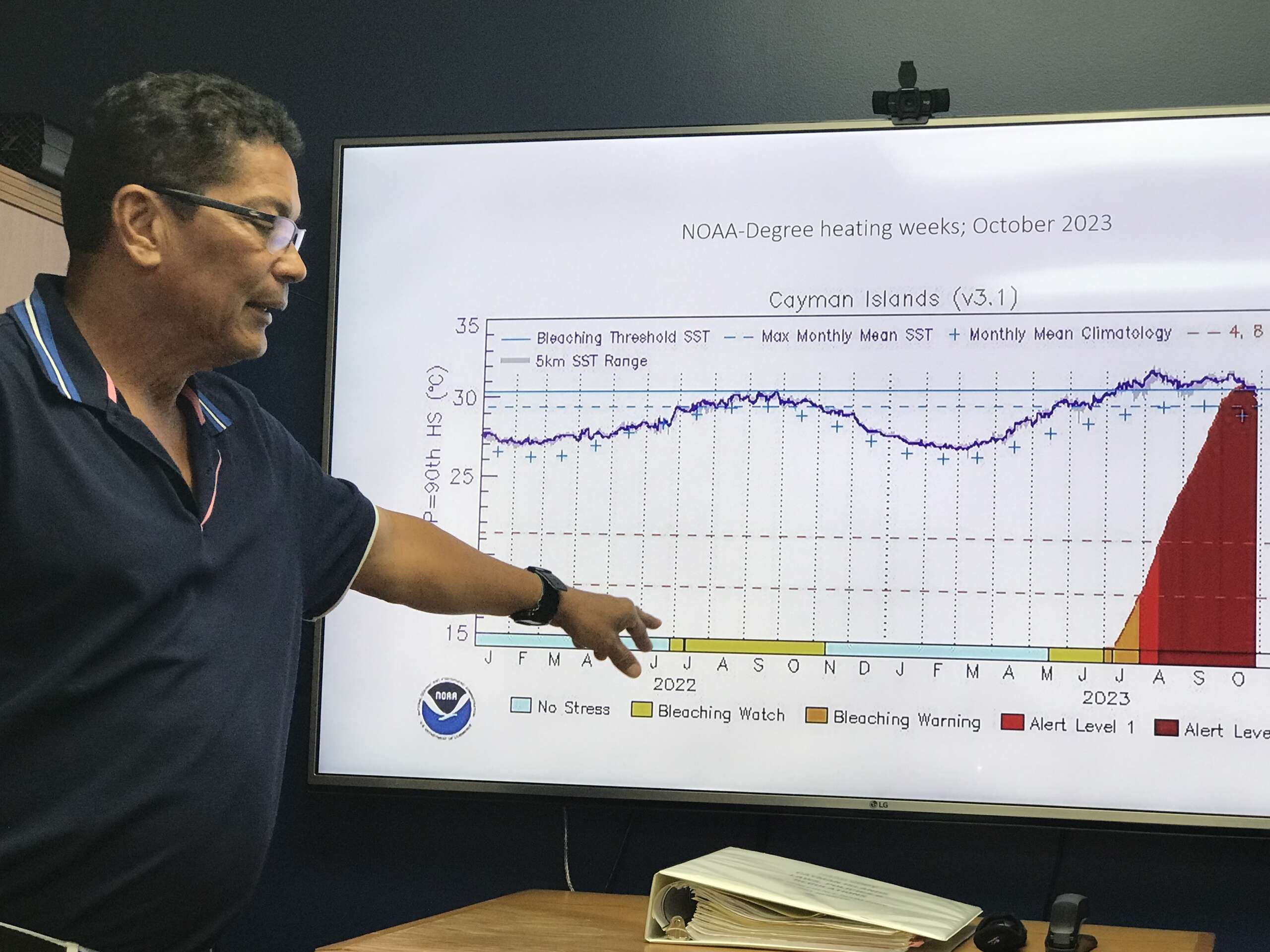
McCoy points to a chart with an alarmingly dark-red peak that indicates ‘Alert Level 2′. The chart shows that Cayman was under a ‘bleaching watch’ in May and June last year, rising to a ‘bleaching warning’ in July, then to Alert Level 1 in August, before moving to Alert Level 2 in mid-August, and lasting until late October.
“By October usually each year, it’s cooled down… but this was extreme. It went up [to Alert Level 2] in August and it stayed there for an extended period of time,” McCoy said. “That was very alarming and concerning.”
He added that sea surface temperatures did not start going down until November.
And this was a scenario that was repeated around the globe.

At the time, Alert Level 2 was the highest level of threat, meaning the sea surface temperature was at or above the bleaching threshold, and indicating a risk of reef-wide coral bleaching with mortality for heat-sensitive corals.
But following the hottest year on record last year, NOAA changed the alerts its Coral Reef Watch issues, adding three new levels of risks. Bleaching Alert Level 2 warns of a risk of death of multiple species on the reef, while Level 4 indicates a risk of severe multi-species mortality. And Level 5, the most serious, means there is a risk of near-complete mortality of corals, with more than 80% of corals on the reef expected to be lost.
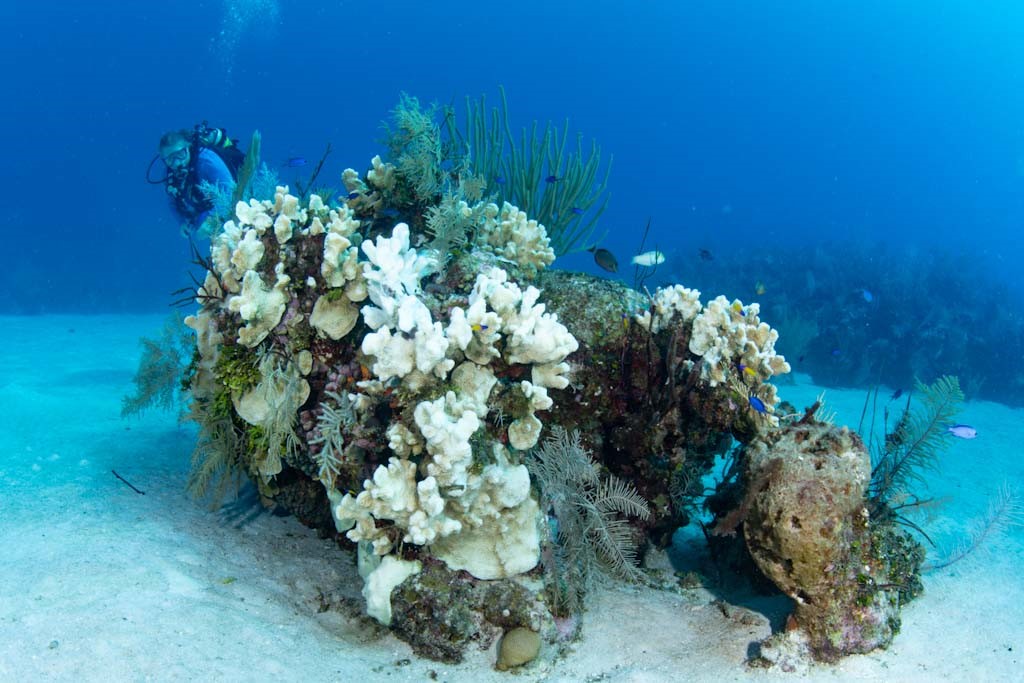
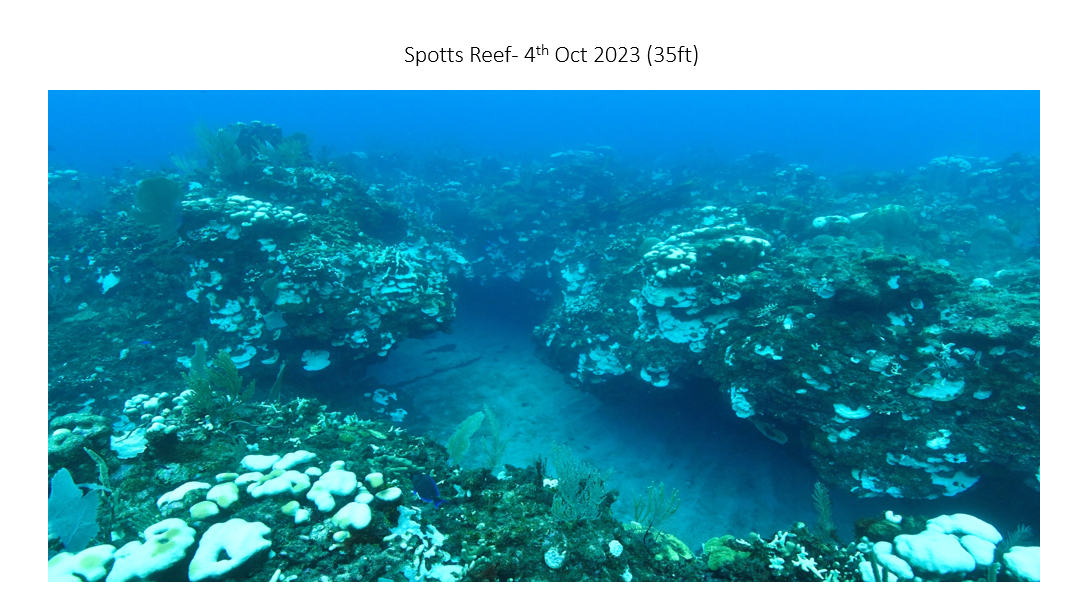
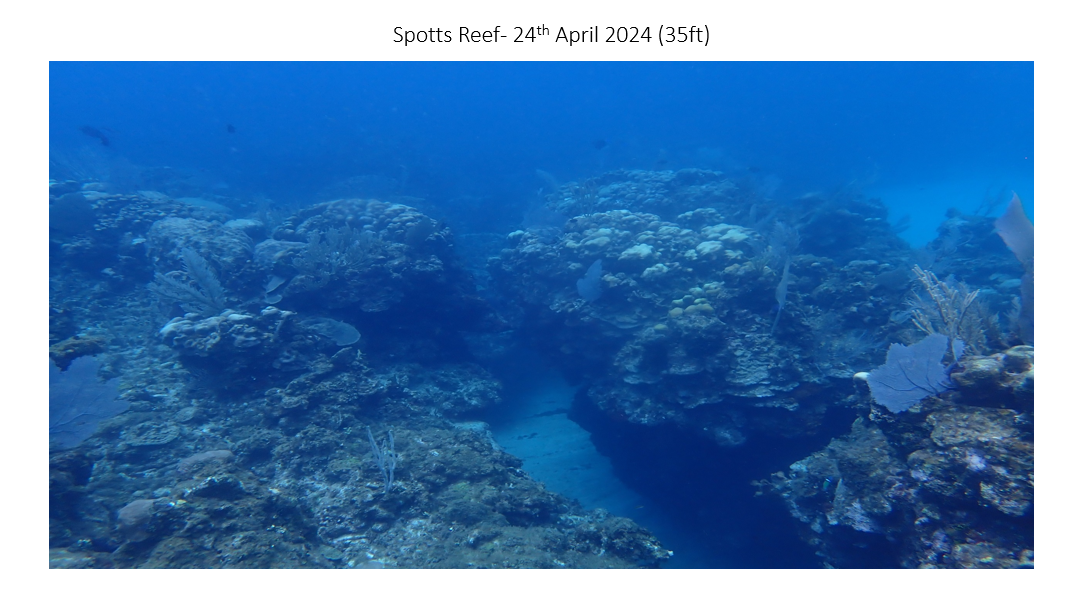
McCoy shows a series of photographs taken at Spotts Reef on Grand Cayman, at a depth of 35 feet (see below). The October 2023 image shows the reef with large areas of it looking like snow-capped mountain tops. A photo taken in April 2024 shows a much duller scene, with much of the site covered in brownish-green algae.
 Tim Austin, DoE’s deputy director of research and assessment, who works with McCoy on monitoring corals reefs, points to another of the images in McCoy’s presentation, which show the year-by-year deterioration of massive coral heads on a local site, Andes Reef, over the last three decades.
“Those corals are in excess of 500 years old,” he said. “They were alive when Columbus sailed right by here, and on our watch, we’ve lost them. You don’t see any corals that size in Cayman anymore.”
The concerns over the survivability of reefs are being addressed by scientists around the world in a variety of ways, one of which includes growing corals in tanks in laboratories, that would eventually be planted on the reefs.
At the DoE lab in Cayman, the researchers have also collected fragments of various types of coral from the local reefs – ones that have survived stony coral tissue loss and other diseases, and have proved to be resistant to the high water temperatures.
It’s those ‘resilient’ corals that some scientists are pinning their hopes on. If they can grow them in a lab and outplant them to the wild reefs when the sea cools, these corals stand a chance of survival, and of eventually repopulating denuded reefs.
McCoy says the DoE has the ‘tips’ of many pillar corals in its lab. “We’re gene banking them basically, and we hope to spawn those,” he said, explaining that they were among the most susceptible corals to stony coral tissue loss disease.
Another threat to the reefs is ocean acidification, which inhibits a coral’s ability to produce the limestone, or calcium carbonate, needed to grow its skeleton, and “they become very brittle and they break off”, McCoy explained.
“Then you get bio-erosion too. We’ve seen an increase in bio-eroders, like sponges, and in a storm, these corals snap and break off, and this reduces the amount of fish. It’s one big eco-system and the fish depend on it.”
Locally gathered data shows there has also been a drop in the percentage of reefs covered by Favidae – the family of larger corals, like brain, star or cactus corals – between 1997 and 2021. The mean percentage cover of those types of coral in 1997 was about 15%; by 2002, that had fallen to 7.5%, and between 2013 and 2021, it was 5%.
“These animals build the largest structures on the face of this Earth. They’re the reef builders. They build ‘skyscrapers’, things that are visible from space – the Great Barrier Reef, the Mesoamerican Barrier Reef System, just west of us here; they’ve been around for millions of years,” McCoy said.
NOAA says the global bleaching event “requires global action”. Already, marine scientists worldwide are cooperating and sharing information on coral health, as they did on how to tackle stony coral tissue loss disease.
Related Videos








Part of the problem is over fishing. There are few large fish as opposed to years ago when there were many. As someone who does about 150 dives a year I can see the difference from 10-15 years ago.