

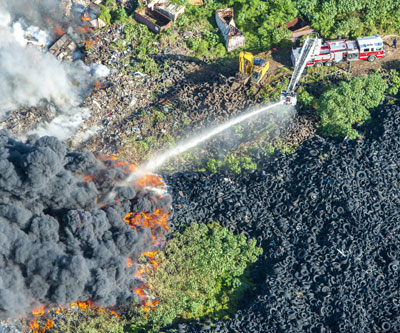

When the dumping of garbage on the site of what is now part of the George Town Landfill began in 1963, no one, least of all the owner of the land at the time, could have envisioned what has become known as “Mount Trashmore.”
As he related to the Cayman Compass in a 2013 article, then-owner of the property, George Seymour, only wanted to use trash to fill in the swampy land so he could use if for raising cattle.
Editorial: GT landfill: Process is not progress
Because there was an increasing issue of what to do with solid waste, other Grand Cayman residents also started using the site to dump trash. In 1972, the government leased the land to use as a garbage dump, although it was seen only as a temporary arrangement that would last eight years. Eventually, government acquired ownership of the land and eight years has extended to 41 years – so far.
Since the dump was started by private individuals without government consultation, there were no systems incorporated to prevent environmental damage from leachate or gas migration.
By the end of the 1980s, Cayman’s legislators realized that a problem was developing with the George Town Landfill, and over the past 25 years a steady stream of politicians has discussed the issue, formed committees and commissioned studies to investigate solutions, and made promises that haven’t been kept.
A growing problem
During his contribution to the budget debate on Nov. 29, 1989, then-Executive Council Member for Health Ezzard Miller was asked to explain a $900,000 allocation for consultancy in the budget, part of which he said would be used for a study on solid waste management for Grand Cayman, Cayman Brac and Little Cayman.
“Because whether [those questioning the allocation] want to believe it or not, solid waste – garbage – is becoming a serious problem in this country,” he said.
Mr. Miller spoke of “the threats of pollution from leach heads” and “the threat of a methane bomb going off on the outskirts of George Town at any time.
“If they think this is not a problem, go up to the dump and walk around,” he said. “Look at the leach head that is threatening the North Sound.”
Mr. Miller said the government had been consulting with representatives of the Pan American Health Organization and the World Health Organization about the issue “on a regular basis for some time.”
On Feb. 21, 1991, Mr. Miller told the Legislative Assembly that additional land had been purchased adjoining the George Town Landfill site, but the study he had referred to in 1989 was still being conducted. He elaborated extensively on the scope of the study, which was undertaken by the U.S.-based firm Post, Buckley, Schuh and Jernighan, Inc.
“The purpose of this study is to advise the Cayman Islands government on the social, environmental and economic implications of the various technological alternatives for the disposal of solid waste and to determine the most appropriate method of solid waste management for the Cayman Islands,” he said, adding that the study would include Cayman Brac and Little Cayman.
The terms of reference for that study included preparing a comprehensive solid waste management plan for the Cayman Islands, Mr. Miller said.
The study was ultimately completed in September 1992 and was cited in the Strategic Outline Case for an Integrated Solid Waste Management System document prepared by the current government in April 2014. That Strategic Outline Case stated that the 1992 study “found heavy metals (chromium and iron) and PCBs present in sediment samples in a canal adjacent to the landfill. Iron, chromium and mercury were found in algae, mangrove and sea grass samples and, mercury was found in fish samples at higher levels than expected. Whilst none of the concentrations were yet at toxic levels, these results were obtained 20 years ago and at that time the report recommended that ‘the results should be used as a motivating force to limit the discharge of leachate to surface waters around the landfill and to further investigate the distribution of contaminants on near-shore commercial marine species.’”
Back burner
Instead of the PBS&J recommendations becoming a motivating force to resolve the George Town Landfill problem, a change in government in November 1992 put the issue on the back burner.
The problems of the George Town Landfill came up again in July 1998, when MLA Roy Bodden asked Executive Council member John McLean a question about “the seepage of pollutants and contaminants at the North Sound landfill site.”
“The government is at this time not controlling the seepage of pollutants from the George Town Landfill,” Mr. McLean responded. “Waste of all types, including hazardous wastes, have been discharged into the George Town Landfill.”
Noting that the unlined, non-engineered site “is not the best technology,” Mr. McLean said that one of the challenges for the government would be “to facilitate the establishment of an environmentally sound waste management facility in the near future.”
Mr. McLean said that a committee had been formed several months earlier and had been working diligently on the issue.
“[I]t is definitely a concern and not something that any of us would like to see continue the way it has been operating.”
MLA Kurt Tibbetts asked if there had been any tests done to “see if there has been any excess pollution into the North Sound,” to which Mr. McLean said that his understanding was “that there has been seepage over the years,” although he could not say if there had been any reports written on the testing.
“It is obvious from the answers that have been given to the supplementaries that this is a very serious matter,” Mr. Tibbetts said, and asked how long the ministry had been aware the situation was acute as it was.
“The garbage facility has never been in place the way it should have been,” Mr. McLean responded. “It has been done, as we all know … in an ad hoc way. We have been trying our best to contain it.”
Capacity
The issue of the capacity of the George Town Landfill was raised in the Legislative Assembly in November 1998 by Roy Bodden, who cited a report that suggested the landfill had a lifespan of only four or five years before being filled to capacity.
The following March, Mr. Bodden again brought up the subject through a parliamentary question, asking the government about its plans for the development of an alternative landfill site on Grand Cayman.
Mr. McLean said that the development and siting of a landfill had to be considered “in the context of a general integrated waste management system that addresses all of the waste stream components.”
MLA McKeeva Bush asked if the government still intended to create another landfill site.
“I think that there is no other way but to try to develop another landfill for the future,” Mr. McLean said.
Two years later, in March 2001, MLA Eugene Ebanks asked about the expected life of the government landfill and the plans for the future of the landfill.
Leader of Government Business Kurt Tibbetts, who was by this time the Executive Council member with responsibility for the landfill, said that based on the calculations at the time, there were only two years of capacity remaining, but that the Department of Environmental Health was examining the possibility of “stretching the existing footprint” north to gain more capacity. However, he said, the goal was to construct a new solid w
aste disposal facility in two years.
“In preparation of the eventual closure of the George Town Landfill, the Department of Environmental Health has completed an Alternative Systems Analysis …” Mr. Tibbetts said. “This study characterizes the current solid waste system and presents several waste management alternatives for the future and the costs of implementing them. A common thread among all alternatives is the need for a new landfill. I am prepared to table this study for the benefit of the Legislative Assembly and to commence the public debate over future alternatives.”
In the interim, Mr. Tibbetts said that the Department of Environmental Health would “begin a landfill site selection process in preparation for the closure of the George Town Landfill within the next two years.”
Two months later, on May 24, 2001, Mr. Tibbetts tabled the “Alternative Systems Analysis Sold Waste Feasibility Study for Grand Cayman” that had been prepared by Post, Buckley, Schuh and Jernighan, Inc.
Mr. Tibbetts’s term in the Executive Council ended prematurely six months later after a vote of no confidence that resulted in his becoming the leader of the opposition.
During the budget debate in February 2005, opposition MLA Alden McLaughlin asked the government what it was doing about “the abysmal situation in relation to the landfill in Grand Cayman.”
He noted that in 2000, the Legislative Assembly had been told the landfill only had “18 months to run.”
“I have asked question after question in this honorable House and in Finance Committee what is being done to deal with the growing problem of disposal of solid waste in this country, and I have been met each and every time with some technical, diplomatically worded response, but nothing concrete has reached my ears about what government is really doing about the matter,” Mr. McLaughlin said.
Changing governments
Several months later, Mr. McLaughlin’s and Mr. Tibbetts’s government returned to power for four years, with their colleague at the time, Arden McLean, assuming Cabinet-level responsibility for the landfill.
In May 2006, Mr. McLean said he had attended the North American Waste-to-Energy Conference in Tampa, Florida, and that he was planning to visit “a few plants – composting, waste-to-energy – just to see if that is what this country needs.”
“I am going to address it,” he said. “It might not be within the middle of the tenure, but within 18 months I promise this country I am going to have a solution for it.”
Exactly one year later to the day, Mr. McLean again spoke about the landfill, saying he had a meeting with “the subcommittee of the committee that I have set up to look at … the management of solid waste in the Cayman Islands.
“This is a very important aspect of this country and we can no longer turn a blind eye to it,” he said.
Mr. McLean announced that within a few days he was taking the entire committee to the North American Waste-to-Energy Conference in Florida, the same conference he had attended the year before, “for us to get a better understanding of what we are dealing with and make some contacts.”
Current Cabinet minister with responsibility for the landfill, Osbourne Bodden, who was then a backbench MLA for the People’s Progressive Movement government, was impressed by Mr. McLean’s efforts.
“This is the first time, I think, that we have a real effort at our solid waste problem,” Mr. Bodden told the Legislative Assembly in May 2007. “I think everyone can see that it is paying dividends. Mount Trashmore, as the minister likes to call it, is certainly looking, at least the area around it, a lot better. I think that we are finally coming to grips with how to handle our waste, which, for a small country, we certainly generate a lot of.”
In September 2007, in response to a question, Mr. McLean told the Legislative Assembly that the Solid Waste Strategic Management Committee was established “to assist us in an advisory capacity by researching, reviewing, compiling, and updating the Waste Disposal Options Review report, which was 2003, and by considering and making recommendations for the most suitable, municipal solid waste management strategies and procedures as they relate to waste-to-energy, waste reduction, reuse and recycling in the Cayman Islands.”
Mr. McLean was asked when the Cayman Islands might see a system that delivered alternative energy of some sort. He responded by saying, “I have made quite a number of trips overseas with some of the [Legislative Assembly] members here to look at some of these alternative energy sources from solid waste,” he said. “It is my intent to review these in order that members on that committee and I will get a better understanding of what we are dealing with because we are no experts.
“As a matter of fact, we travel to … Nevada in the next few weeks to look at products – SWANA, Solid Waste Association of North America, I think it is – their display over there.”
With regard to how long it would take to get the plant built, Mr. McLean said, “these things take a while.”
“What my hopes are, is … some time [in] the latter part of next year … to at least have a contract in place with someone to have a waste-to-energy plant in this country. Now we are looking at two years,” he said. “Hopefully. we should see this thing by 2010, I would like to think.”
Then in November 2007, 18 months after Mr. McLean promised the country he would have a solution for the landfill problem within 18 months, he outlined what the Solid Waste Strategic Management Committee had accomplished to date in an effort to fulfill its mandate.
“I am proud to report that this committee has made much progress in this endeavor,” he said. “It has thus far made recommendations on the reorganization of the three landfills in the country, met with major importers, and produced a report on an education and public relations strategy.”
As a result of the committee’s recommendations, Mr. McLean said the government had engaged consultants to provide further assistance.
“I can assure the people that my ministry is working tirelessly to address the many issues surrounding solid waste management in the country,” he said.
During the budget session the following year, it was Leader of Government Business Kurt Tibbetts and not Mr. McLean who addressed the landfill issue, saying only, “The government continues to be committed to the development of a waste-to-energy facility. That program will be moving as swiftly as we are able to allocate funds.”
The issue then went to the back burner again, and the facility didn’t materialize before the elections in May 2009 took the PPM government out of power.
Recent developments
After the United Democratic Party took over, Leader of Government Business McKeeva Bush said early on that “a decision would be taken on proposals to address the important issue of the Grand Cayman landfill, with special attention to waste-to-energy possibilities.”
After initially pursuing the waste-to-energy solution, the landfill became part of the multi-project deal known as the For Cayman Investment Alliance that would have seen it closed, capped and remediated, and a new, modern-engineered solid waste management facility established in eastern Bodden Town.
The establishment of the new facility in Bodden Town became a major campaign issue leading up to the 2013 general elections and ultimately led to the ouster of both UDP Bodden Town MLAs.
After the election, returning Bodden Town MLA Osbourne Bodden was installed as the Cabinet minister with responsibility for the landfill and, only weeks after the vote, he announced there would be no landfill in Bodden Town.
Six months later, the Progressives, as the party became known, announced they would keep the la
ndfill at its current site in George Town, and formed a committee to conduct research and travel to other landfill sites to observe best practices and standards.
Although landfill fires have been a long-standing issue at the George Town Landfill – Ezzard Miller told the Legislative Assembly “the good Lord is lighting them through methane and lightning” back in 1989 – two particularly bad fires in December 2013 and February 2014 created renewed urgency to resolve the solid waste problem.
In early April 2014, Minister Bodden, Premier Alden McLaughlin and two civil servants traveled to Tampa to tour waste-to-energy facilities, landfills and a recycling processing center in order to, as Premier McLaughlin later said, “familiarize ourselves with various waste management systems.”
The premier also announced that finding and implementing a sustainable, solid waste management system was “an increasingly urgent issue for the Cayman Islands.” He said the tours of the solid waste management facilities “reinforced my belief in the importance of having an overarching strategy when looking at solid waste management.”
Mr. Bodden detailed to the Legislative Assembly a staged process for the development of a George Town Landfill solution. Stage one, he said, was to produce a Strategic Outline Case, which was published and made public in late April.
He said the Strategic Outline Case would form the basis for a request for proposal for consultants to deliver a national waste management strategy “that will help to better identify the project options for assessment,” which will in turn give way to consultants identifying a preferred project option.
In a letter to the editor of the Cayman Compass on July 24, 2014, Mr. Bodden offered the following details about the George Town Landfill project:
Construction on a waste management plant should start in 2015, be finalized in 2016 and become operational in 2017.
The plant will “likely cost at least” $100 million.
The government doesn’t know “what plant or what costs” it will end up with.
The plant won’t cost the Caymanian people anything, but [the cost will] be borne by an unknown investor who will be repaid over a long-term period of at least 20 years.
The government doesn’t think it will have a problem finding solutions and strategic partners for the process to address the landfill problem.
In his address to the Legislative Assembly in April, Mr. Bodden said his ministry, the Department of Environmental Health and the project steering committee were all “working assiduously to identify and implement an integrated solid waste management system for the Cayman Islands, and as part of this process we will, for the first time, have a national solid waste strategy to guide them in their work.”
“Does this process take time?” Mr. Bodden asked rhetorically. “Yes it does; there is no question about that.”
For the residents of Grand Cayman, the amount of time is 25 years and counting.
Related Videos












Leaching from the dump has probably already done irreparable damage to North Sound. I speak from personal experience having watched the marine life disappear from the water at the back of my house in Omega Bay.
It seems as though no one wants to deal with this issue because it is nothing short of catastrophic and the perceived fears are indeed real.
This is a monumental health hazard folks and before it’s too late, deal with it.
Enough studies already. This is your health and putting a bandaid on a gaping gash is not going to work.
The government is responsible and it seems as though everybody is looking at everybody else to do something. So get off your behinds and do something.
No offense to the Compass on this but I literally got a headache reading this as well a plenty a laughs just reading about all the BS and talk that has been done about what to do with the dump. One thing I see is that they are very good at creating committees and sub committees of these committees, travelling to view other dumps as well as ordering study after study while doing nothing. After forcing myself to read through this and sort through all the BS that has taken place about the dump the one thing I come up with is that the most realistic option or idea that anyone put on the table was the offer from Dart to handle the situation for us and in my opinion it still is. After reading the whole timeline of what went on over the last 25 years, I have no confidence at all that anything will get done if left in the hands of the CIG.
Darn it, man, let Dart clean that stink up before they change their mind and it’s too late.
Excellent job Compass! The only study is in order now to measure the extend of toxic waste accumulation in human bodies,animals, vegetation and soils.
Cancer,autoimmune and autonomic disorders registry might come handy here to stir people into action.
I read a lot of comments in the compass as well the Cayman News Tabloid, where people bash the Compass saying that they are hyping to much on this situation just because they want the Dart deal to happen. What I see is the compass printing factual reasons why everyone should support it and that because it’s obvious that if left to the CIG nothing will get accomplished. I don’t know Dart, don’t work for him and I certainly don’t live in Camana Bay, but what I do know is that they put their money where their mouth is and they actually get things done when they say they will. And the things that they have done are all done in good taste with a high quality. So I for one personally think that if allowed to Dart would quickly remedy this situation if not for us, they would do it for themselves and we would benefit from that.
Compass why not have poll to see what the general population thinks.
This is the type of problem that does not have a simple solution that everyone will agree upon. That being the case it scares politicians who fear they will end up like the former UDP MLAs from Boddentown prior to the last election.
It seems that at the end of the day getting reelected trumps solving national problems because the reelection is based upon district votes.
I doubt this government has the will or the stomach to resolve the dump problem. I truly hope they prove me wrong.
Congratulations Alan Markofffor the informative historical sequence of events which you have provided on the George Town Landfill. As a former Minister of Government, I can fully appreciate the financial and other difficulties facing the current Minister, as he attempts to properly address this urgent matter. It is with this understanding in mind that I would fully encourage the Hon. Osbourne Bodden to reopen discussions with the DART Corporation/or other viable source as soon as possible, and attempt to reach a mutually acceptable compromise, which will be, generally, in the best interest of the people of the Cayman Islands. I realize that by expressing my views on this controversial issue that I am opening myself up to possible political abuse. However, I would consider such an eventuality as a small price to pay if my comments are able to provoke positive debate on what may properly be regarded as one of the top priorities in the Cayman Islands. While I appreciate that the increasing deterioration of the George Town Landfill concerns each one of us,let us nonetheless endeavour to confine our comments to constructive criticisms rather than leveling personal vitriolic attacks at those who are currently tasked with the constitutional responsibility for addressing this major problem.
Worth checking out –
http://news.uk.msn.com/uk/diggers-tackle-giant-smouldering-waste-mountain-in-cul-de-sac/
This isn’t just a Cayman Islands problem.
To David Williams. I checked it out and the article says that….Environment Agency contractors have entered the Waste4Fuel site … in an operation to lower the illegal waste pile to a safe level….
Who exactly has executive power, issue executive orders which have the force of law in regards to The Dump? Is it in the power of a single man, or a single body of men to jeopardize health of the 50,000 people?