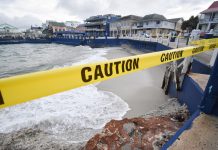
Cayman’s role as a major financial centre gives the territory the chance to play a significant role in changing the planet’s future for the better, according to a sustainable finance expert.
Climate change represents both a major risk and an opportunity for those investing in or investing from the Cayman Islands, Arnaud Van Dijk, Director of KPMG IMPACT in Grand Cayman told the Compass.

“On the investment side climate is key,” said Van Dijk. He said anyone putting money into infrastructure in the territory should want to know their project is ‘climate proof’.
He added, “If you are financing infrastructure that is supposed to be there for 30-40 years, you need to imagine what the world will look like at that time.
“As a result, our clients increasingly ask us to ‘stress test’ their investments against various climate scenarios.”
In the fiduciary sector, he said, KPMG IMPACT was also helping businesses develop environmental, social and corporate governance structures which help calculate, among other things, their exposure to climate related risks.
“These scenarios include aspects related to physical climate change, such as rising sea levels and increased frequency of storms, as well as transition risk which stem from the transition to a low-carbon economy, such as carbon pricing, regulations to limit carbon emissions and changing consumer preferences,” he said.
As major jurisdictions like the European Union and the United States move forward on their climate ambitions, funds in Cayman will be under increasing regulatory scrutiny to show their portfolios reflect ambitious global targets for a carbon-neutral future. These targets are relevant not only to large institutional investors, but for anyone planning their future financial needs, van Dijk said.
“If you are investing your money for retirement, you want to know the asset manager is taking into account climate considerations. Many of us would want to be able to retire in a world that is climate resilient and more sustainable.”
Survey asks: Can capital markets save the world?
A recent study by KPMG International, CREATE-Research, and the Chartered Alternative Investment Analyst Association involving 90 institutional investors and titled ‘Can capital markets save the planet?’ examined the role investors can play in driving progress on climate change.
Fighting the tide
- Could Cayman’s financial sector help save the planet?
- Premier seeks to tackle ‘existential threat’ of climate change
- Small force protects Cayman’s waters from man-made threats
- Organised poaching gangs threaten survival of key species
- Cayman 2050? How surging seas could redraw the map
- What does Cayman’s environment contribute to the economy?
- The issue explained: Putting a price on nature
- Expert: ‘Climate threats already impacting Cayman’
- Climate change’s biggest threat may be to Cayman’s economy
- Cayman braces for impact as ‘climate catastrophe’ looms
The majority of those surveyed said they did not believe climate risks were adequately factored into securities prices.
That’s beginning to change, however.
The study also showed that 54% of investors were targeting a new ‘double bottom line’ of doing well financially and environmentally.
Last year, the UK became the first country in the world to mandate businesses, investors, pension funds and asset managers disclose data on their environmental impact, including exposure to climate risks. A similar framework is not yet in place in the Cayman Islands.
A key challenge remains identifying exactly what data should be required to promote transparency in climate reporting.
But discussions between industry experts and government are under way and Van Dijk believes environmental, social and governance metrics are increasingly being factored into investing decisions.
He is convinced the world is moving towards a global standard where such disclosures will be as common as anti-money laundering compliance requirements.
Climate-proof investing – or ESG investing as it is referred to more broadly – is an area that has taken off in the last two years. Many businesses still do not fully understand their exposure to climate or broader ESG opportunities, Van Dijk warns. “We are just at the start of the quest for better data.” But he sees huge opportunity for the Cayman Islands to take a leading role.
“There are so many funds here, there is a unique opportunity for Cayman to be a sustainable financing hub,” he said.
“The take-home for businesses and governments of all sizes is that they should be ready for both the effects of a changing climate and decide what role they will play in the transition to a low-carbon, more sustainable society. It is about planning for what the world could look like and influencing a better outcome at the same time.”
Related Videos